
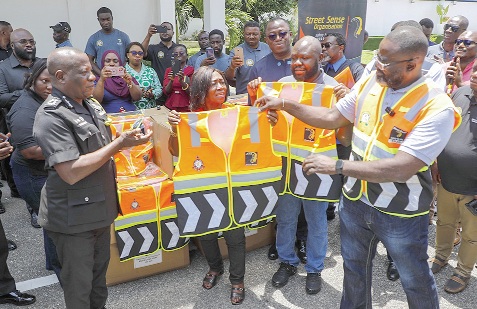
The Inspector-General of Police, Christian Tetteh Yohuno, has raised concern about the spate of carnage on the roads and charged drivers to be extra careful to ensure the safety of the travelling public.
He gave the charge in Accra last Wednesday when Street Sense Organisation, a road safety entity, presented 1,000 reflective vests to the police service ahead of the commencement of the new traffic management system, TRAFFITECH-GH.
He said drivers should be mindful of pedestrians crossing the road, traffic officers managing traffic and other road users, and, therefore, drive cautiously.
“Let's try to reduce the number of casualties we encounter daily.
Many people leave their homes with the intention of going and coming back, and then some drivers have the intention that they have to drive very fast so that they can catch more passengers.
That money that you get would not be worth the accidents that you cause on the road.
“So, our driving public, let us all talk to them.
Let's advise them that let us be very careful on the streets so that we can be able to reduce the carnage we encounter on the streets,” he said.
Mr Yohuno said road accidents were among the most frequently recorded incidents on a daily basis across the country, adding that their occurrence was higher than that of any other sickness or disease suffered by people in the country.
Currently, he said, there were not less than 3,000 police personnel on the streets daily trying to manage traffic.
He thanked Street Sense Organisation for its support to the police, and added that the gesture would solve almost one-third of the clothing problem of the personnel on the streets on a daily basis.
Government
Mr Yohuno said at least for now, the government provided those facilities to personnel to enable them to discharge their duties.
He said due to the harsh nature of the weather, there was the need to change the reflective vests worn over the uniforms to perform their duties.
“A lot of our personnel have suffered casualties as a result of the lack of these reflective jackets, and some are on hospital beds nursing injuries.
I think it’s very good getting this at this time — especially when we are rolling out this TRAFFITECH-GH programme,” he said.
On the new traffic management programme, he said it should have commenced on October 1, 2026 but was rescheduled to November 1, 2026 to allow for more education of the motoring public.
“It was supposed to start October 1, 2026, but more time has been given to the motoring public so that a lot of education and sensitisation will be given to people to know the next phase of traffic management,” he said.
Presence
The police, he said, would continue to show their presence on the road to ensure that they reduce the incidents of accidents on the highway and in the metropolis.
For his part, the National Coordinator of Street Sense Organisation, Samson Oddoye, said the donation was to aid the police in their work to ensure safety on the roads.
He said Street Sense was a local non-governmental organisation that, among other things, supported the Motor Traffic and Transport Department (MTTD) of the Ghana Police Service to promote road safety.
He said the organisation also assisted in sensitising members of the public on safe road-use practices, as well as supporting agencies such as the National Road Safety Authority, the MTTD, the Ministry of Transport and the National Ambulance Service in educating the public on road safety.
Mr Oddoye said the organisation had a cadre of dedicated people who had identified with its purpose by giving of their service free of charge to disseminate information.
A former Chief Executive of the Korle-Bu Teaching Hospital, Dr Opoku Ware Ampomah, said most people who were killed on the roads were those in their productive years.
