
The Ministry for the Interior has called on security agencies to deepen trust and strengthen engagement with civilians as part of efforts to tackle emerging security threats effectively.
The ministry said security agencies could not respond effectively to increasingly complex threats without building strong relationships with the communities they serve, and that all security agencies, including the Police Service, Immigration Service and the Ghana Armed Forces, must build trust with civilians.
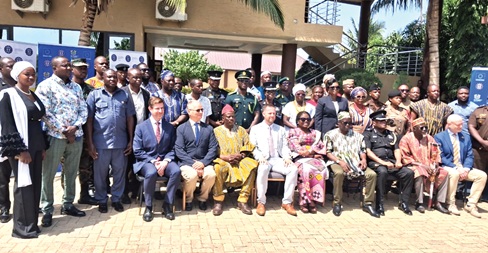
The Technical Adviser to the Minister of the Interior, Commissioner of Police (COP) Maame Yaa Tiwaa Addo-Danquah, made the call at the opening of a three-day workshop on Strengthening Inter-Agency Law Enforcement at Regional Security Council (REGSEC) and Community Levels in Bolgatanga last Tuesday.
According to her, transparency, respect, sustained engagement and effective communication were essential to building public confidence and ensuring the timely flow of information between security agencies and civilians.
“Security today is defined by relationships. Relationships that are built on transparency, respect and sustained engagement,” she said.
The programme, which brought together representatives of the security services, traditional authorities, political parties, community opinion leaders, youth leaders, the National Peace Council, the media, civil society organisations and other stakeholders, aimed to strengthen collaboration, communication and trust in security management.
The workshop, supported by the European Union (EU), is a pilot programme intended to be replicated in other regions and at the district level.
Collaboration
COP Addo-Danquah said the evolving security landscape required security institutions, political actors, traditional authorities, civil society and communities to work together.
She said effective engagement, timely information sharing and coordinated responses had become indispensable tools for maintaining peace and preventing conflicts.
“No single institution can succeed alone. We have to work together,” she said.
She explained that the training had been designed to deepen collaboration and equip participants with practical tools for effective engagement and communication.
COP Addo-Danquah said the entry into force of the National Security and Intelligence Agencies Act, 2026, provided a formal basis for strengthening the practical functioning of the Regional and District Security Councils and their collaborative relationships with communities.
Trust
The Upper East Regional Police Commander, DCOP John Ferguson Dzineku, said police-community trust remained critical to the fight against crime.
According to him, the police had dismantled seven armed robbery syndicates operating in parts of the region, including Yagaba, Fumbisi, Navrongo, Bolgatanga, Pelungu, Tongo and Gbane and seized weapons including AK-47, G3, M16 and CZ rifles, pistols and several rounds of ammunition through intelligence-led operations.
He said the Upper East Region had, over the years, become a haven for criminals, partly due to the spillover of conflicts, resulting in armed robberies that had claimed innocent lives, including those of security personnel whose weapons were taken away, thereby creating fear among residents.
“Since the retrieval of these weapons and arrest of these guys, the region has known a little bit of peace up to now.
It is said that policing is not done to the people, but is done with the people.
Without trust, information does not flow.
And without information, we cannot fight crime,” he said.
The Deputy Head of the European Union Delegation to Ghana, Jonas Claes, said the EU was pleased to support the initiative, which focused on strengthening inter-agency law enforcement and community engagement through improved collaboration and trust-building.
He said the EU had worked closely with the Ministry of the Interior and expressed confidence that the partnership would continue.
Security threats
The Upper East Regional Minister, Donatus Akamugri Atanga, said the region's location along Ghana's international boundary with Burkina Faso made it strategically important to the country's security architecture.
He said the region faced threats including chieftaincy and land disputes, transnational organised crime, irregular migration, cross-border criminality, violent extremism from the Sahel, trafficking, misinformation and disinformation.
