
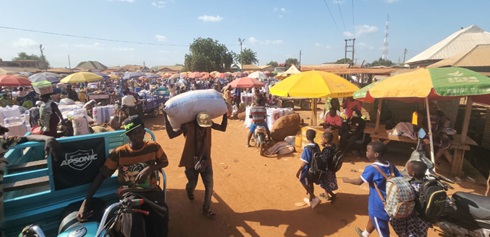
For market women in Bawku, the sound of gunfire was more than a reminder of the insecurity gripping their community.
It was often a warning that the day's business could end abruptly, customers would disappear and goods painstakingly arranged for sale would be abandoned.
For some, the consequences went beyond lost sales.
They included unpaid loans, mounting debts, difficulties feeding their children and the painful uncertainty of not knowing whether they would be alive to open their stalls the following day.
For children, laughter was often drowned out by gunfire and some grew up knowing little about Bawku beyond its reputation as a place where dreams died young.
Their journeys to school could be cut short at any time, forcing them to return home, while schools remained closed for extended periods, denying them access to education.
For ordinary Ghanaians living outside Bawku, visiting its once-vibrant market became a gamble with their lives, an option they would consider only as a last resort.
For security personnel, Bawku was a place where they were not only expected to protect lives and property but also needed protection themselves.
That was the sad reality at the height of the protracted conflict in Bawku, a once-bustling commercial centre in the Upper East Region whose economic and social life was severely disrupted by recurring violence.
The ugly days
Since the re-emergence of the conflict in 2021, police records have indicated that more than 200 lives had been lost as of 2024, although some residents believe the figure was an underestimate.
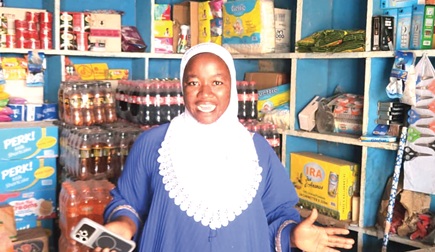
Hajia Safia, a trader, transacting business at her provisions store which hitherto was closed
More than 180 people were left with disabilities during the period, according to the municipal disability association.
Additionally, more than 300 children were orphaned following the loss of one or both parents to the conflict, according to figures from the Upper East Regional Coordinating Council as of 2024.
Schools were closed, markets shut down and freedom of movement restricted from dusk to dawn.
Today, however, the story is different and encouraging.
The winds of peace are blowing across the vibrant town, opening the hearts of aggrieved residents and armed men to the realisation that the loss of lives cannot be the solution to the conflict.
Every life lost represents a setback and a deprivation of freedom and livelihood.
The easing of the curfew, the lifting of the ban on motor riding, increasing economic activities, the movement of factions into previously restricted areas and the gradual return to normality offer glimpses of hope that Bawku is moving towards its glorious days as a major destination for business people.
It has been 209 days without gunfire in Bawku and residents have expressed optimism that the painful past is gradually becoming a thing of the past.
A resident of Bawku, Hawa Aminu, said, “We are enjoying the moment and I must say that the time for peace in Bawku is now. We do not want to hear gunfire again.
“If the shedding of blood were the solution to this conflict, we would still have some of our sons alive because their grandfathers' blood should have been enough to solve it.
“But it is obvious that killing one another will not bring a solution.
It will deepen the identity crisis and only worsen the situation over time. So, as a mother, I want to tell everyone that they should let peace be the ultimate winner of this conflict,” she said
Another resident, Alhassan Azumah, said, “We have all experienced what it means to live under a curfew, to leave the house without being certain whether we would return alive.
“That experience is ugly and I must say that we are enjoying the current atmosphere of peace. I want to call on all of us to continue working to maintain it.”
A trader at the Azoka Market in Bawku, Hajia Safia, said the prevailing peace was encouraging and expressed the hope that the town would never return to the ugly scenes of the past.
“I am very happy that there has been peace for some time now.
During the height of the conflict, my store was closed, but now we are back here selling.
The only challenge is that there is little money in the system, so the market is not moving as expected. However, now that there is peace, I know things will change for the better,” she said.
A preparatory school learner in Bawku, Abdul Wahap, said he was happy to be back in school and particularly excited that he could now sit in the classroom without fear.
“Now, even when a car tyre bursts, we do not shiver because we know it is not a gunshot.
I am happy to be in school to learn new things,” he said.
Master Wahap added, “I want to tell my parents that they should not fight again because we want Bawku to be peaceful so that we can go to school and take care of them when they grow old.”
A nurse, Felicity Dakurah, said the prevailing peace was welcome and urged the factions to continue engaging in dialogue to sustain it.
“I am not from here, but I have been working in Bawku since 2020 and I must say that we are enjoying this moment of peace.
“For the first time, my siblings visited me just last week from Tumu in the Upper West Region without even calling ahead.
This tells you the level of confidence people have now.
I, therefore, appeal to both factions to work towards maintaining the peace,” she said.
Another trader, Sandoo Nbugri, said that although business activities were not progressing as expected, the prevailing peace was worth celebrating.
“I sell farm inputs and for now, things are not moving as fast as expected, which is understandable because only those engaged in irrigation farming are my customers at the moment.
“However, I think the level of peace we are enjoying means everything to us and we must all work to maintain it,” he said.
Beyond the ceasefire
President John Dramani Mahama, during his visit to the Upper East Region in August 2026, expressed optimism that sustained peace would help Bawku regain its position as a major commercial centre.
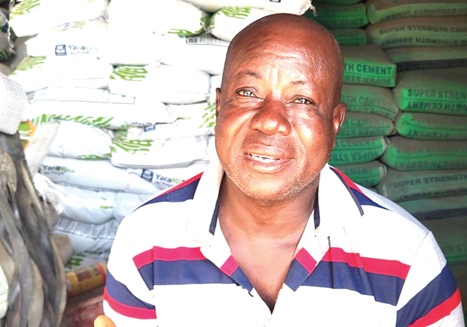
Sandoo Nbugri, a trader, in his store in the market
He said the return of calm provided an opportunity for residents to begin rebuilding their lives and reviving economic activities disrupted by the conflict.
“As the guns have stopped sounding in Bawku, we have an opportunity to begin the process of rebuilding and revitalising the area. Bawku will bounce back,” he said.
Fund
The President reiterated that the committee established to oversee the disbursement of the GH¢1 billion Bawku Revitalisation Fund would support the recovery and development of the area following the restoration of relative calm.
In a statement on the Bawku peace process in September 2026, the National Peace Council encouraged traditional and religious leaders, women and young people to demonstrate leadership and commitment to peaceful coexistence.
The council stressed that lasting peace must be owned and protected by the people themselves.
It also emphasised the importance of dialogue and responsible communication, urging the media, commentators and social media users to verify information and avoid sensational or inflammatory content capable of heightening tensions.
The Upper East Regional Minister, who is also the Chairman of the Regional Security Council, commended both factions for their cooperation and said his outfit was working with them to ensure that the peace was sustained to pave the way for development.
He noted that reconciliation and social integration were progressing at a measured pace and expressed confidence that government support, including the Bawku Revitalisation Fund, would help sustain the momentum.
Recommendations
A peace and conflict resolution consultant and former Executive Secretary of the Upper East Regional Peace Council, Ali Anankpieng, who has worked in the area for more than a decade, said conflict could not be eliminated because it was an inevitable part of human interaction and social life.
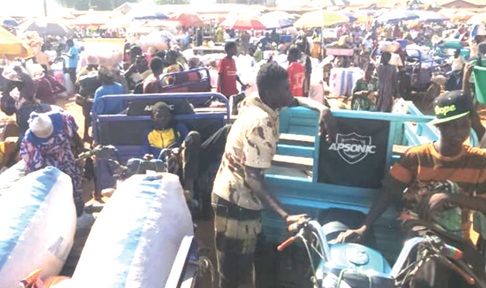
The once empty market is now filled with people
He said what could be achieved was to manage and transform conflicts and prevent them from escalating into violence.
“Sometimes, stopping the gunfire does not mean the conflict has ended.
Beneath the silence may be unresolved grievances, mistrust, perceptions of injustice and historical wounds that, if left unaddressed, can reignite tensions.
“Sustainable peace must, therefore, go beyond the absence of violence to rebuilding relationships and restoring trust,” he said.
Mr Anankpieng added, “Peacebuilding is a continuous process. It is about transforming attitudes, strengthening relationships and creating systems that allow people to disagree without engaging in violence.
“Ultimately, the true measure of peace is not the absence of differences but the ability to live together despite them.
In other words, the goal of sustainable peace is not to eliminate differences but to transform how people respond to those differences, and we must all work to realise this in Bawku.”
The General Officer Commanding the Northern Command, Brigadier General Franklyn Worlanyo Agbebo, also commended stakeholders for contributing to the prevailing calm and urged them to sustain their commitment to peace.
He said his outfit remained focused on sustaining the peace in Bawku.
