
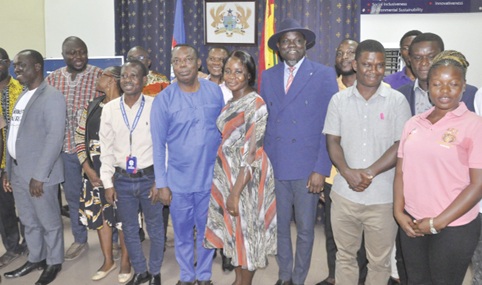
A Euro 54,000 project to map out the population of Baobab trees in the Ghana was launched at the Ho Technical University (HTU) on Monday (October 5).
The BAOMAP Project, using remote sensing and ground verification will be implemented jointly by HTU, and Centre for Scientific and Industrial Research (CSIR), in partnership with the with Rhine-Waal University in Germany, with funding from the German Government.
The project is expected to be completed by the end of this year.
The BAOMAP project follows HTU’s recent research innovation which has helped to reduce the gestation period from between 27 and 30 years to only 27 months.
Objectives
The objective is to announce BAOMAP and its national relevance, and build s a stakeholder ownership and cooperation for a field access information platform, community entry and data use.
It is also to explain expected outputs, benefits, timelines and opportunities for participation, and generate responsible media visibility without overstating results that have not yet been produced.
The Vice Chancellor, Professor Ben Q. Honyenuga, who launched the project, said the Baobab, which could live for about 200 years, had a critical role to play in national development, taking into account its value chain, with the medical and nutritious worth of its roots, seeds, leaves, bud, and fruits.
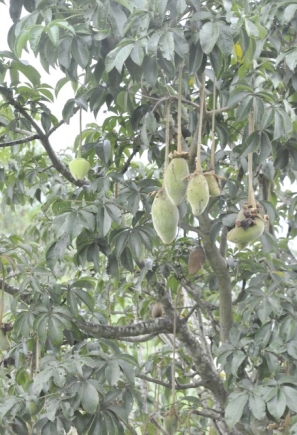
A baobab tree at HTU bearing fruits bountifully after only 27 month
“Taking censors of the tree will help to promote its sustainability, conserve nature, and reverse the effects of climate change,” he said.
Professor Honyenuga said the project would definitely lift the national and international images of HTU to sterling heights.
Baobab’s values
Earlier, Director, CSIR-Plant Genetic Resources Research Institute, Dr Daniel Ashie Kotey said in spite of the numerous values of the Baobab tree, the country had not taken deliberate and coordinated steps to adequately document, conserve and utilise the baobab genetic resources.
The project was, therefore, not an isolated scientific project, as it was an effort to build a national knowledge base around an important plant genetic resource, he explained.
Further, Dr Kotey said the BAOMAP project was designed to provide baseline special data on baobab populations that could be harmonised and validated to support long-term monitoring, genetic diversity assessment, planning and policy, as well as sustainable use and benefit-sharing.
Meanwhile, the policy and scientific leader of the project, Professor Kenneth Fafa Egbadzor, said BAOMAP would combine remote sensing with national ground verification to identify and classify baobab populations, collect biometric and ecological data, produce district and national maps, establish a georeferenced national data base, and generate recommendations for conservation, domestication and commercial utilisation.
