

The Konkomba people across Ghana converged on Kpassa in the Nkwanta-North District in the Oti Region last Saturday to celebrate their annual yam festival, Linujil, with a call on the government to establish a modern yam market in the area.
The Linujil festival is celebrated by the Konkomba people to thank God for protecting them throughout the farming season and blessing their lands with bountiful harvests.
This year's celebration, held on the theme, “Sow unity, reap development”, highlighted the strong link between peaceful coexistence and sustainable development.
The festival featured a rich display of Konkomba culture, with patrons dancing to Kinachun, the traditional dance of the people, while also showcasing aspects of yam cultivation.
The event brought together Konkombas from various parts of the country, as well as government officials, including the Northern Regional Minister, Ali Adolf John Mburidiba; the Oti Regional Minister, John Kwadwo Gyapong; and the Board Chairman of the Tema Oil Refinery (TOR), Nayon Bilijo.
Also present were the Members of Parliament (MPs) for Nkwanta-North, John Oti Kwabena Bless; Kpandai, Matthew Nyindam; and Wulensi, Stanley Yaw Nandaya.
Modern yam market
The Paramount Chief of Kpassa, Ubor Tassan Nanja Konja VI, called on the government to construct a modern yam market in the area to improve the economic fortunes of farmers.
He said Nkwanta-North, given its strategic position as a major yam-producing area, was well suited for such a facility, particularly as traders from across Ghana and neighbouring countries travelled there during the harvest season to purchase yams.
”A dedicated, well-structured central market with proper storage facilities, trading shades, and security will not only boost local revenue generation for the assembly but also dignify the sweat of our hardworking farmers and market women.” he said.
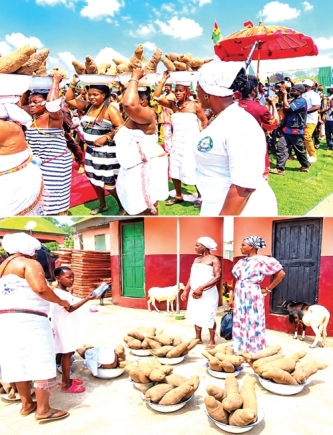
Women in cultural regalia displaying yams at the yam festival celebration
Ubor Konja VI said although the district was predominantly engaged in yam farming, the absence of a modern market had deprived farmers of the opportunity to obtain the full economic value of their produce.
He explained that farmers were compelled to transport their yams over long distances to major markets, including Accra, despite challenges associated with poor road networks.
”By the time they get to Accra to sell the yams, some of the tubers get rotten while some vehicles are also involved in accidents, resulting in losses to the farmers. If we have a modern yam market here at Kpassa, it will take care of farmers from northern Ghana to the middle belt and save them the hustle they go through,” he said.
Economic potential
A Professor of Soil Science at the University of Ghana, Prof. Dora Neina, said yam had enormous economic potential in terms of export earnings and domestic revenue generation.
She described the call for a modern yam market as timely, adding that strategic investment in the yam value chain would help unlock the crop's economic potential and improve farmers' livelihoods.
Prof. Neina urged smallholder farmers to adopt sustainable soil and land management practices to safeguard agricultural productivity, particularly at a time when climate change was adversely affecting farming activities.
She also appealed to Konkombas to invest in the education of girls and promote women's participation in decision-making to advance gender equity.
The MP for Nkwanta-North, John Oti Kwabena Bless, said the celebration of the yam festival was timely and should serve as a wake-up call for stakeholders to harness the economic potential of the crop.
He said Ghana had overtaken Nigeria to become the leading exporter of yam, demonstrating the crop's potential to contribute significantly to the national economy.
"I can say that Konkomba people are the dominant producers of yam.
What we need to do is to ensure that we take advantage of the economic value of yam," he said.
Data
Data from the Ministry of Food and Agriculture indicate that Ghana produces approximately 11.4 million metric tonnes of yam annually, making the crop an important contributor to agricultural gross domestic product (GDP), food security and household incomes.
Yam production is concentrated largely in northern Ghana, with the Northern, Savannah, North East, Upper East and Upper West regions accounting for an estimated 85 per cent of national production output.
However, the concentration of production in the north, hundreds of kilometres from major southern consumption and export centres such as Accra, Kumasi and Takoradi, presents significant transportation and marketing challenges.
Given that yam is transported over long distances on poorly maintained rural roads, coupled with other challenges such as rough handling and inadequate transportation facilities all contribute to post-harvest losses, estimated at about 30 per cent of total production.
The establishment of a modern yam market in Kpassa could, therefore, help improve aggregation, storage and marketing, while reducing transportation difficulties and post-harvest losses for farmers.
