
An incomplete storm-drain project at the Gbemi Stream is emerging as a major flood risk for Ashaiman, with the Municipal Assembly appealing for support for the construction of the drain into a modern storm drain to help alleviate the flooding challenges within the municipality.
The Assembly indicated that continued reliance on the drain, despite it being desilted periodically, could not provide a permanent solution to the flooding challenges in the municipality.
The Assembly says only about 150 metres of the planned storm drain approaching the Starlight Bridge has been completed since work began after the bridge was constructed in 2020, leaving a critical section of the watercourse largely unconstructed.
The Municipal Chief Executive (MCE), Freeman Tsekpo, has renewed the Assembly’s appeal to the relevant authorities, including the Hydrological Services Agency, to complete the project, saying funding remains the major obstacle.
The urgency of the appeal is underlined by Ashaiman’s flood history.
The municipality experienced major flooding in 2010, followed by further incidents in 2018 and 2024.
Mr Tsekpo said extensive dredging and desilting at the Ajei Kojo underbridge, which serves as an exit point for water from the area, helped prevent major flooding during the heavy rains in 2025 and 2026.
But he stressed that such interventions could not replace a properly engineered storm-drain system.
The Gbemi Stream also faces a second challenge: indiscriminate dumping.
Another round of clean-up
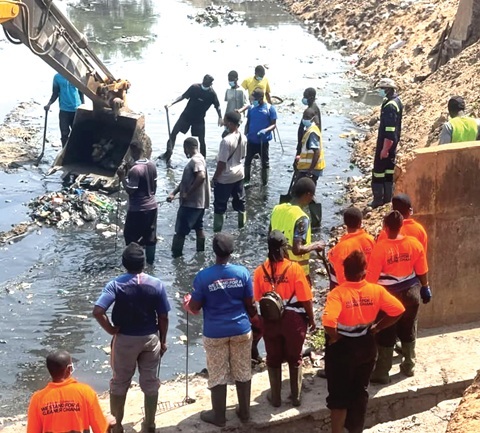
During a recent Municipal Assembly clean-up exercise at the stream, machines and additional workers were deployed to remove refuse dumped into the watercourse.
Mr Tsekpo said residents living along the drain had turned parts of it into a refuse dump, reducing the capacity of the watercourse and increasing the risk of obstruction during heavy rainfall.
“Unfortunately, the people living by the drain have turned this place into their refuse dump.
We are using extra hands and machines to remove all the refuse,” he said.
The Assembly is now combining the clean-up with measures aimed at preventing a return to the status quo.
A monitoring system is being introduced, while owners of pig farms operating around the area have been engaged to help monitor the site and report indiscriminate dumping.
Infrastructure gap
The Gbemi Stream situation highlights the difficulty of managing flood risk through maintenance alone.
According to Mr Tsekpo, the Assembly has repeatedly engaged the relevant authorities through letters, meetings and lobbying for the construction of the storm drain.
For Ashaiman, the challenge is particularly important as development continues to place pressure on existing drainage infrastructure.
An unfinished storm-drain network leaves the municipality dependent on regular dredging to maintain the flow of water.
At Adjei Kojo, the Assembly has consequently adopted regular desilting as a preventive measure.
Mr Tsekpo said the Assembly would continue the exercise while pursuing the construction of a modern storm drain along the Gbemi Stream.
“We are appealing that the Gbemi Stream should be constructed into a modern storm drain to help alleviate the flooding challenges within the municipality,” he said.
Beyond the drain
The Gbemi Stream problem also exposes the link between infrastructure and public sanitation.
Even a completed drainage system could be compromised if refuse continues to be dumped into it.
The Assembly’s decision to involve nearby pig-farm owners in monitoring the area is therefore an attempt to create community-level responsibility for protecting the watercourse.
The issue has broader implications for Ghana’s Sustainable Development Goals (SDGs).
SDG 11 — Sustainable Cities and Communities places emphasis on resilient urban development, making improved drainage infrastructure relevant to Ashaiman’s growth.
The sanitation challenge connects directly with SDG 6 — Clean Water and Sanitation, while investment in drainage and flood resilience supports SDG 13 — Climate Action.
Writer's email
