
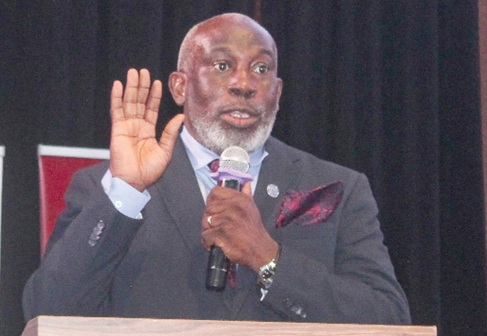
The Allied Health Professions Council (AHPC) has inducted 15,000 graduates with a charge to learn the ropes under supervision before practicing on their own.
The induction and oath-swearing ceremony took place simultaneously in Accra, Kumasi and Tamale yesterday on the theme: "Setting the Standard: Regulating Service, Safety and Excellence across Universal Health Coverage".
The Accra inductees comprised 3,068 medical laboratory professionals (including scientists, technicians and Doctors of Medical Laboratory Science); 1,845 dietetics and nutrition professionals; 1,497 disease control officers and technical officers; 689 health information officers; 624 health promotion officers; and 556 radiography and sonography practitioners.
The rest were 444 community mental health professionals; 371 optometry and optical practitioners (including Doctors of Optometry and optical dispensing technicians); 310 physiotherapists and physiotherapy technicians; 303 environmental health officers; and 199 practitioners across other specialised fields, drawn from 12 professions.
They swore the Allied Health Professions Oath, pledging to put patients first, protect confidential records and seek guidance when unsure.
Caution
The Registrar of the AHPC, Professor Shirazu Issahaku, cautioned that four years of classroom education did not automatically grant them full professional status.
"You are not professionals yet. You are not supposed to go onto the field and start practicing," he said.
Prof. Issahaku explained that the upcoming one-year clinical placement from November 1 to September 30 would serve as a critical learning period under consultant supervision prior to their licensing examination.
He stressed that no health facility would admit an intern without the four mandatory documents: a signed posting letter, a signed code of ethics, a logbook and a logbook summary sheet.
He warned that corrupt acts or misconduct would attract dismissal and a lifetime ban from the council.
Rural postings
The guest speaker and Dean of the School of Biomedical and Allied Health Sciences at the University of Ghana, Prof. Samuel Antwi-Baffour, urged the inductees to accept postings to rural and underserved communities to help realise universal health coverage.
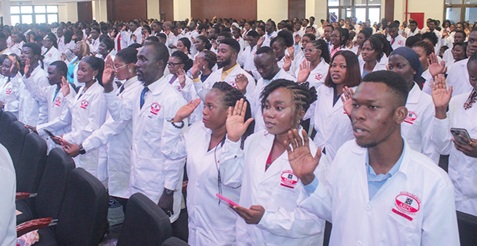
New members into the council
"If the ministry sets up hospitals in the rural areas and professionals refuse to attend to them or go there, then universal healthcare coverage will not be achieved," he said.
Prof. Antwi-Baffour emphasised that technical qualifications represented only the beginning of competence, urging graduates to prioritise compassion, safety and ethical practice.
He advised them to report faulty equipment, acknowledge mistakes promptly to improve patient protocols and adopt digital tools without relinquishing clinical judgement.
