
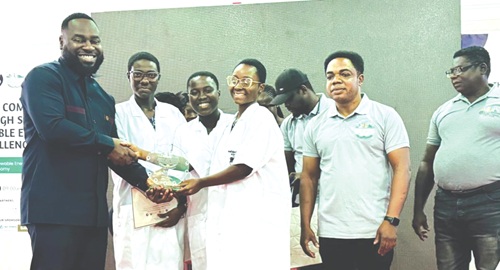
Six Senior High Schools from across the country have qualified for the grand finale of the seventh edition of the Energy Commission Renewable Energy Challenge.
A unique feature of this year’s competition was that champions of the previous six editions in the southern and northern zones competed among themselves, paving the way for the selection of the best three schools from each zone for the Champions of Champions contest.
The competition is an initiative of the Energy Commission aimed at encouraging young people to develop an interest in renewable energy, science, technology and innovation.
Out of nine schools that competed in the southern zone, the Ahantaman Girls’ Senior High School, the Presbyterian Boys’ Senior High School (PRESEC), Legon and the Kpando Senior High School emerged as the top three finalists.
In the northern zone, the Dabokpa Technical Institute, the Yaa Asantewaa Girls’ Senior High School and the OLA Girls’ Senior High School secured places in the grand finale out of eight participating schools.
The annual competition, organised by the Energy Commission with support from its partners, is being held on the theme: “Harnessing Renewable Energy to Power Ghana’s 24-Hour Green Economy”.
The grand finale has been scheduled for November 17, 2026, at the auditorium of the University of Professional Studies, Accra (UPSA).
Practical solutions
The Deputy Executive Secretary of the Energy Commission, Chris Yalley, said the competition was intended to encourage students to look beyond classroom learning and develop practical solutions to the country's energy challenges.
He said renewable energy sources such as solar, wind and biomass offered numerous opportunities for Ghana to explore.
Mr Yalley said the theme was particularly relevant as the country worked towards building an economy in which businesses and industries could operate around the clock.
“For a 24-hour economy to succeed, we need a reliable, affordable and sustainable energy supply. Renewable energy has an important role to play in making this possible,” he said.
He urged the students not to underestimate their ideas and creativity, saying with the right support and determination, their innovations could develop into solutions that would transform communities.
He added that Ghana's energy future depended not only on engineers, scientists and policymakers but also on young people willing to think differently, ask questions and develop innovative ideas.
The National STEM Coordinator of the Ghana Education Service, Emmanuel Ocquaye, said a 24-hour economy required reliable, affordable and sustainable electricity, even when solar and wind resources were unavailable.
He said the country also needed energy solutions for farmers, health facilities, artisans and traders, particularly those in remote, island and lakeside communities not connected to the national electricity grid.
Writer’s email;
