
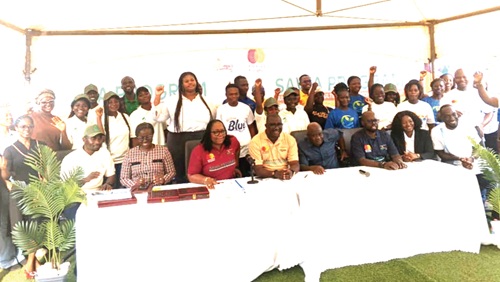
The Mastercard Foundation, in partnership with Agri-Impact Ltd, has launched a four-year initiative aimed at creating 60,000 jobs for young women in Ghana’s aquaculture industry, including 3,000 opportunities for women with disabilities.
The Sustainable Aquaculture for Women Advancement (SAWA) programme, running from 2026 to 2030, seeks to increase women's participation in fish production, processing and marketing while positioning aquaculture as a driver of inclusive economic growth.
The programme is also targeting an additional 50,000 metric tons of fish production annually, with projected yearly revenue of US$90 million.
It is being implemented with several public and private sector institutions, including Newage Agric Solutions, Agro Kings, the Fisheries Commission, TechnoServe and the Council for Scientific and Industrial Research (CSIR).
Other partners include Aglow Farm, Afrigem Global Investment, Naple Betta, Centre for Enterprise Learning, with auditing firm PricewaterhouseCoopers (PwC) as the institutional strengthening partner.
The Chief Executive Officer of Agri-Impact Limited, Daniel Fahene Acquaye, disclosed this at a partnership signing ceremony in Accra on Monday, November 2, 2026.
He said the programme was designed to address structural challenges in the aquaculture industry and empower young women aged 18 to 35 across rural, peri-urban, and urban Ghana to become entrepreneurs and business leaders in a sector traditionally dominated by men.
Mr Acquaye said Ghana has considerable potential to increase fish production through its rivers, lakes, streams, and other inland water resources, but it still depends heavily on imported fish.
The SAWA programme, he explained, would help bridge the gap by expanding domestic production, developing entrepreneurial skills, promoting research commercialisation and addressing policy constraints that discouraged young people from entering the industry.
Mr Acquaye explained that under the programme, strategic partnerships with the Council for Scientific and Industrial Research (CSIR) and the Fisheries Commission would provide regulatory oversight to ensure that production and processing activities met national aquaculture standards.
Mr Acquaye stressed that access to fingerlings and feed alone was insufficient to guarantee success in aquaculture, adding that beneficiaries also needed infrastructure, reliable markets, technical expertise, mentoring and sustained business support.
Some partners, he added, had already begun training hundreds of young women and providing them with fingerlings to commence production.
He expressed optimism that private sector participation would sustain the initiative beyond its four-year implementation period by linking investments to productivity, profitability and market demand.
Opportunities
The Chief Executive Officer and Founder of Agro Kings, Nana Owusu-Achau, said his company was committed to creating opportunities for women beyond fish production, particularly in processing, value addition, marketing and distribution.
A participant in the project, Mama Oye Obeng Koranteng, said the initiative would equip young women with the technical knowledge and practical skills needed to establish sustainable businesses.
She appealed to the partners to address barriers confronting women in the industry, particularly those with disabilities.
Writer's email:
