
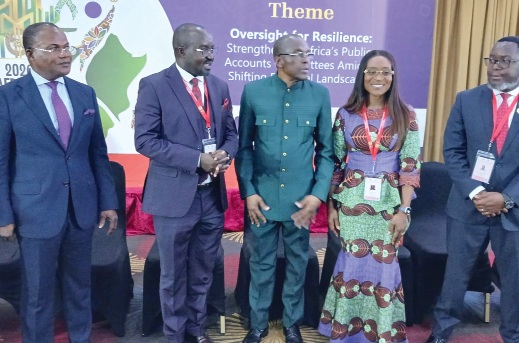
Place Auditor-Generals and audit institutions under Parliament rather than the Executive to strengthen financial accountability and also prevent conflict of interest in the management of public resources, the Speaker of Parliament, Alban Sumana Kingsford Bagbin, has advocated.
He said the system where audit institutions operated under the executive undermined their independence as they were required to scrutinise the same government that appointed them, adding “once they are appointees of the Executive, they owe their loyalty to the Executive.”
He was addressing this year’s African Organisation of Public Accounts Committee (AFROPAC) conference and general meeting in Accra yesterday.
The four-day event is on the theme: “Oversight for resilience: Strengthening Africa’s public accounts committees amid a shifting financial landscape.”
It is aimed at strengthening the capacity of PACs across Africa to provide effective parliamentary oversight, promote fiscal accountability and protect public resources amid changing financial and economic conditions.
It is being attended by Speakers of Parliament, parliamentary leaders, heads of Supreme Audit Institutions, finance officials and delegates from across Africa.
Responsibility
Mr Bagbin, who is also the Chairperson of the African Parliamentary Network Against Corruption (APNAC), said Parliament had a responsibility to ensure that public officials accounted for resources entrusted to them.
He, therefore, urged PAC members to discharge their oversight responsibilities without fear or political considerations, saying they must have the courage to confront public officials over financial irregularities and mismanagement.
Mr Bagbin called for adequate financial and institutional support for PACs, adding that their work was significant to be constrained by limited budgets.
The Speaker also urged Parliament to strengthen collaboration with the media to ensure that findings of PAC hearings translated into concrete actions.
He observed that in many countries, including Ghana, reports submitted by the committees were not adequately debated on the floor of Parliament, thereby limiting public awareness of their findings and recommendations.
The Speaker further encouraged African parliaments to enact laws to regulate professional practice to ensure that people entrusted with financial responsibilities possessed the requisite qualifications and ethical standards.
Tracking recommendations
The Vice-Chairperson of AFROPAC, Abena Osei-Asare, called on PACs across Africa to track government loans, revenue collection and the implementation of audit recommendations.
She said the changing financial landscape, rising public debt and pressure on government revenues required stronger parliamentary scrutiny to protect public resources.
“Our parliaments must follow every loan contracted and every tax collected,” Mrs Osei-Asare added.
The Vice-Chairperson, who is also the (NPP) MP for Atiwa East, said the effectiveness of PACs should not be measured by the number of public hearings conducted or audit irregularities uncovered, but by the corrective actions taken to prevent their recurrence.
The Minority Leader, Alexander Afenyo-Markin, also said that the effectiveness of PAC should be measured by the corrective actions taken, funds recovered and sanctions imposed, rather than the number of public officials summoned for hearings.
Enforce sanctions
In an address read on his behalf, the Minister of Finance, Dr Cassiel Ato Forson, also urged African governments to sanction officials responsible for financial irregularities, saying persistent audit findings without consequences undermined public accountability.
“Reports are presented, hearings are held, recommendations are issued, and the doom loop continues.
We must break this as accountability without consequences is just documentation,” he said.
“We cannot keep asking our citizens to contribute more taxes, while allowing waste, leakages and financial indiscipline to drain the public purse,” he said.
