
The Minister of Environment, Science and Technology, Dr Zanetor Agyeman-Rawlings, has called for stronger links between universities, governments and the private sector to ensure that scientific discoveries translate into practical solutions for Africa’s development challenges.
She said inadequate funding, weak partnerships and limited commercialisation opportunities continued to prevent research findings from moving beyond laboratories into industries and the marketplace.
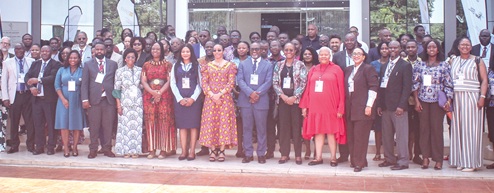
The minister made the call at the opening of the 2026 O.R. Tambo Africa Research Chairs Initiative (ORTARChI) Annual Gathering at the West African Genetic Medicine Centre, University of Ghana, Legon, last Monday.
The ORTARChI has established research chairs in seven African countries, including Ghana, to strengthen research excellence, scientific leadership and collaboration across the continent.
The three-day gathering was on the theme: “Bridging science and enterprise in Africa: Translating academic research into industrial and business impact.”
Strengthen research funding
Dr Agyeman-Rawlings said Africa needed more than scientific discoveries to address its development challenges, stressing the importance of building systems that would enable research to deliver tangible benefits.
“Africa's challenge is not merely to produce more research. It is to build the institutions, partnerships, financing mechanisms and markets that enable research to create lasting value,” she said.
She urged African governments to increase domestic investment in science, technology and innovation, describing it as critical to industrial development and economic growth.
The minister cited the operationalisation of the Ghana National Research Fund as an important step towards strengthening research support, but emphasised the need for predictable funding and measurable outcomes.
She also called for stronger collaboration among universities, industry and government, saying such partnerships must be adequately financed and assessed based on results.
Dr Agyeman-Rawlings further highlighted the importance of science communication in attracting investors and creating opportunities for collaboration.
She announced that the ministry would review its MEST Visibility Webinar Series and introduce an initiative to celebrate scientific excellence among Ghanaian researchers.
The minister stated further that the country’s 2026–2029 Sector Medium-Term Development Plan and the National Science, Technology and Innovation Policy (2024–2030) prioritised environmental sustainability, climate resilience and the transformation of innovation into enterprise.
The Chief Executive Officer of the Oliver and Adelaide Tambo Foundation, Natasha Ali, urged researchers to ensure that their discoveries served society rather than remained confined to academic publications and laboratories.
“Custodianship is not ownership,” she said, emphasising that scientific knowledge should benefit communities, industries and future generations.
Ms Ali said the initiative honoured the legacy of Oliver Reginald Tambo by strengthening Africa’s research capacity and supporting the development of solutions to the continent’s challenges.
She cited research at the University of Ghana on modernising indigenous food processing and work in Tanzania applying nanotechnology to malaria control as examples of how scientific discoveries could address practical needs.
She said participants would use the three-day gathering to engage industry, governments and funding institutions to develop an action framework for translating discussions into concrete commitments.
