
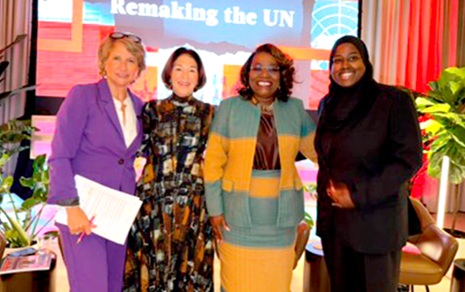
The Deputy Chief of Staff, in charge of Finance and Administration, Nana Oye Bampoe Addo, has called on the world to support the Accra Reset and judge it by results.
She said Africa was building the capacity to act on its own priorities rather than asking for charity.
Speaking at a Ford Foundation Fireside Chat in New York recently, Nana Oye Bampoe Addo, who is also the Presidential Advisory Liaison to the Accra Reset Secretariat, set out the principles guiding Ghana’s efforts to remake global governance.
As part of reforming the United Nations, she argued that it is high time Africa got two permanent seats on the Security Council, with all the rights of permanent membership, including the veto, adding, “It is unacceptable that a continent of 54 nations and well over a billion people has no permanent seat on the Council”.
“My continent did not write the rules of the house it now lives in,” Ms Bampoe Addo said, noting that only four of the 51 states that signed the UN Charter in 1945 were African, and that at the time Ghana was still a colony.
She said reform had won much on principles but little on structure.
The Deputy Chief of Staff stressed that the Security Council had been enlarged only once in 1965, and its permanent membership had not changed since 1945.
She restated Ghana’s position, which was the common African position, the Ezulwini Consensus and Sirte Declaration.
“The central problem is not in the Charter. It is in the condition of the membership,” she said.
“When debt service decides what a clinic can spend, a state’s equal vote is formally intact and practically hollow,” Ms Bampoe Addo stated.
She also briefed the forum about the reparatory justice, the next steps and the steps Ghana was taking to exert its financial independence after completing its 17th IMF programme.
“We replaced external conditionality with domestic oversight,” she said.
Health support
On ending talks with the United States (US) on a $109 million health agreement over access to national health data, she said: “Saying no to one clause is what makes the rest of a partnership credible.”
Nana Oye described the Accra Reset, co-founded by President Mahama and former Nigerian President Olusegun Obasanjo, and launched in Accra in August 2025, as a movement to take Africa “from development dependency to development sovereignty”.
It asks four questions of every proposal: can Africa finance its own priorities, produce rather than only supply, negotiate from knowledge, and build institutions that outlast programmes?
With official development assistance (ODA) down 23.1 per cent in real terms in a single year, she outlined Ghana’s own response: health funding projected above GH¢74 billion this year, a five-year plan for local pharmaceutical manufacturing in a country that imports up to 70 per cent of its medicines, and the Ghana Labour Exchange Programme, under which she saw off 47 health professionals to St Kitts and Nevis in June.
“The Accra Reset is not a parallel United Nations,” she said. “It has no legal personality. It is not asking for a seat anywhere.”
Its founding Northern Co-Steward is the Kingdom of Spain, and it works with the World Health Organisation (WHO), Gavi and the Global Fund.
The fireside chat coincided with the launch of the Global Reset Dialogue in New York, which took the endorsement of the Accra Reset High-Level Panel’s report and launched the Reform Interlock and Observatory (RIO) and the Health Investment National Gateways Enabler (HINGE).
“If you believe the United Nations should be made up of members who can deliver what they sign, then support this work,” she said.
