
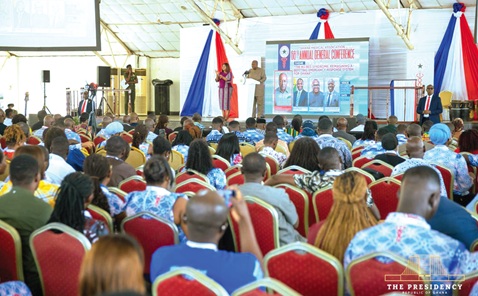
President John Dramani Mahama has announced that the Accident and Emergency (A&E) units at the Korle Bu, the Komfo Anokye and the Tamale Teaching hospitals, as well as the 37 Military Hospital, would be expanded from next year so that emergency beds make up at least 10 per cent of each hospital’s functional bed capacity as part of a new push to end the “no-bed syndrome.”
At Korle Bu, the A&E ward will increase from 65 beds to at least 150.
The President made the announcement yesterday at the 68th Annual General Conference of the Ghana Medical Association (GMA), held at Miotso near Prampram in the Greater Accra Region.
The conference was on the theme: “No-Bed Syndrome: Reimagining a Befitting Emergency Response System for Ghana”.
Present were the Minister of Health, Kwabena Mintah Akandor, and the President of the GMA, Professor Ernest Yorke.
Bed management platform
President Mahama said the expansion would be matched with adequate staff, equipment, oxygen and essential supplies to make the additional capacity operational.
He further stated that the government was also rolling out the Integrated Bed Management and Referral Coordination System (IBMRCS), a digital bed-management platform to help hospitals and ambulance teams identify facilities with capacity to receive patients and coordinate transfers.
The pilot involves the Korle Bu, the Komfo Anokye and the Tamale Teaching hospitals, the Greater Accra Regional Hospital at Ridge, the 37 Military Hospital, the University of Ghana Medical Centre and the National Ambulance Service.
He said the system would help prevent situations where critically ill patients were turned away without assessment.
“If the patient comes in a critical condition, you do not just say, ‘no bed, no bed.’
At least, take a look at the patient; if you can provide stabilisation, provide it and then coordinate a safe transfer,” he said.
Emergency response
The President also announced that the Ghana Armed Forces Critical Care and Emergency Hospital was opening to the public from today to provide additional capacity for emergency cases and bring military and civilian health services into closer cooperation.
Touching on workforce deployment, he said 100 doctors had accepted postings to underserved communities, up from 25 previously, while 8,000 health workers had been recruited this year, with another 8,000 expected by the end of the year, bringing the total to 16,000.
He said 106 districts had been identified as underserved and plans were advanced for financial and non-financial incentives to retain health workers in those areas.
On financing, President Mahama said the 2026 budget allocated approximately GH¢22.8 billion to the Ministry of Health and its agencies, with about GH¢11.3 billion in transfers to the National Health Insurance Fund, including GH¢2.26 billion for the Ghana Medical Trust Fund.
He said the NHIA now makes monthly payments for vetted claims, while tariffs had been increased by 50 per cent since August this year. He warned that facilities charging patients extra fees outside the NHIS would be dealt with.
President Mahama further announced plans to procure 100 new ambulances and spare parts to return broken-down ambulances to service, complete the Police Hospital expansion to 300 beds, complete the La General Hospital next year and reactivate 35 Agenda 111 hospitals that are at least 70 per cent complete.
He asked the GMA to provide practical recommendations on emergency care, workforce deployment and implementation of the government’s health reforms, saying the government would continue to work with the association to translate engagement into better services.
Rethink emergency
The president of the Ghana Medical Association called for a broader rethink of emergency care, arguing that the “no-bed syndrome” is not merely a shortage of beds but a failure across the entire patient journey.
Prof. Yorke said a bed becomes useful only when it is matched with equipment, personnel and services, and urged hospitals to examine what happens before a patient arrives at the entrance, after admission and during referral.
“Responsibility for finding appropriate care should not fall on relatives running from one hospital to another,” he said.
Prof. Yorke called for direct communication between referring and receiving teams, with clear information on the patient’s condition, treatment already given and services required.
