

Buakwa State College at Kyebi in the Abuakwa South Municipality in the Eastern Region is facing major infrastructural and staffing challenges, affecting effective teaching and learning.
The challenges include an uncompleted ICT laboratory block, inadequate classrooms, the absence of a library, a boys’ dormitory and a clinic, as well as shortages of furniture, computers and teaching and learning materials.
The school is also grappling with inadequate staff accommodation, a shortage of 23 teachers and illegal mining activities close to the campus, which generate noise and disrupt academic activities.
The absence of a perimeter wall has also raised security concerns, including the potential intrusion of unauthorised persons.
These challenges came to light at the school's 61st Speech and Prize-Giving Day, held recently on the theme, “Discipline: A Critical Tool for Holistic Development in the 21st Century”.
The Headmaster, Eric Hanson Adjei-Sarpong, said the introduction of the Free Senior High School policy had contributed to an increase in enrolment, which currently stood at 2,762 students, comprising 1,492 males and 1,270 females.
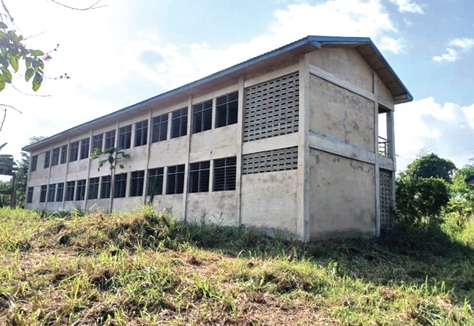
A stalled one-storey boys’ dormitory facility
He said the growing population had resulted in congestion in classrooms, dormitories and the dining hall, despite the school's use of the academic transition calendar.
He explained that the school had a staff strength of 189, comprising 124 teachers and 65 non-teaching staff, but only 34 were accommodated on campus.
The remaining staff members commute daily from communities including Koforidua, Tafo, Suhum and Kyebi and their surrounding areas.
Mr Adjei-Sarpong said the situation placed additional pressure on teachers, who had to travel considerable distances to report for duty.
He said the school had a deficit of 23 teachers, with Physics, Government, Social Studies, General Science, History and Religious Studies among the subject areas most affected.
To address congestion and improve academic work, he said the school required a 12-unit boys’ dormitory block, a 12-unit classroom block and the rehabilitation of the old dining hall or construction of a multi-purpose hall with a seating capacity of 300.
He also called for the completion of the ICT facilities and the provision of functional computers.
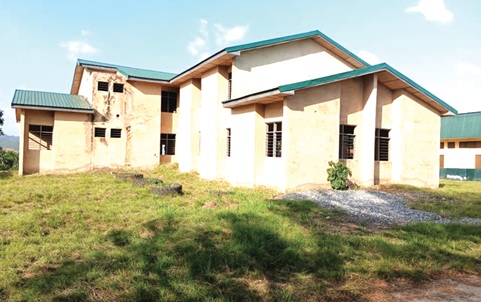
Uncompleted ICT laboratory block
Mr Adjei-Hanson indicated that the activities of illegal mining, popularly called "galamsey", operating close to the school had made teaching and learning very difficult because their big equipment made a lot of noise during teaching hours.
He appealed to the Abuakwa Municipal Security Council (MUSEC) to intervene to address the situation and safeguard lives and property.
He further called on the government, educational stakeholders and benevolent organisations to support the school in addressing its infrastructural challenges.
Mr Adjei-Sarpong said the institution had continued to make academic progress despite the challenges confronting it. On the school's performance in this year's West African Senior School Certificate Examination (WASSCE), Mr Adjei-Sarpong said while some students had performed encouragingly, others had recorded disappointing results.
He identified Core Mathematics, Elective Mathematics, Physics, Economics, Literature in English and Integrated Science as subjects in which students had performed poorly.
He, however, commended the teachers for their commitment and dedication to imparting knowledge, adding that the students were eager to learn and improve their academic performance.
History
Mr Adjei-Sarpong said the school was established in 1937 as a preparatory institution to prepare Ghanaian students for the Junior Cambridge examinations. It was subsequently upgraded to its present status and relocated to Kyebi through the efforts of Nana Sir Ofori Atta I, the then Akyem Abuakwa paramount chief.
Mr Adjei-Sarpong commended the government for supporting the school with infrastructure, including a boys’ dormitory and teachers’ accommodation facilities, through the Ghana Education Trust Fund (GETFund).
He, however, expressed concern about delays in completing some of the projects and appealed to the contractors to return to site and expedite work.
Parental responsibility
The Deputy Director-General in charge of Management Services at the Ghana Education Service (GES), Professor Smile Gavua Dzisi, called on parents to work closely with teachers to promote discipline among students.
She said effective character formation required cooperation between parents, teachers and other stakeholders, adding that parents had a responsibility to instil discipline in their children.
Professor Dzisi urged parents not to take the law into their own hands or attack teachers when their children were disciplined for misconduct.
She said the GES remained committed to providing holistic education but required the support of parents, communities and other stakeholders to achieve that objective.
“Respect is not weakness; it is the strength to put the community's good alongside your own.
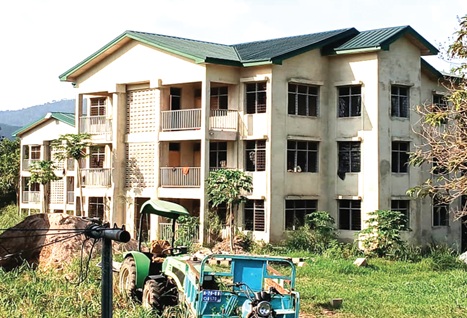
A stalled three storey teachers’ accommodation block
A school without discipline is merely a building without anything in it,” she stated.
Future leaders
The Vice-Chancellor of Garden City University, Professor Eric Kwasi Ofori, who chaired the function, reminded students that discipline, commitment, consistency and continuous learning were essential to becoming responsible future leaders.
He said young people needed more than academic certificates to succeed in an increasingly competitive and rapidly changing world.
He identified good character, critical thinking, creativity, digital responsibility, innovation and the willingness to take responsibility for one's future as important qualities students needed to develop.
“Opportunities may open doors, but discipline, hard work, integrity and perseverance are essential to sustaining progress and achieving meaningful impact,” he said.
Professor Ofori explained that discipline went beyond obeying rules and regulations to include self-management, remaining focused on personal aspirations and making responsible decisions.
He appealed to teachers, school management, parents and the Old Students Association to continue working together to nurture responsible, competent and productive citizens.
The Chief of Akyem Pano, Barima Ofori Akari Opare Ahuntahunu II, urged the students to study hard and respect their teachers and parents to become responsible citizens.
He appealed to the government, well-to-do Ghanaians and non-governmental organisations to support efforts to address the school's challenges.
The Boys' Prefect, Caleb Opoku Abredu, a Form Three student, told the Daily Graphic that the absence of a library and perimeter wall, inadequate furniture and uncompleted infrastructure projects were among the major challenges facing the school.
He appealed to the government and organisations committed to education to assist the school with the necessary facilities.
At the ceremony, deserving students, as well as teaching and non-teaching staff, were recognised for their hard work and contributions to the development of the school.
Writer's email
At a glance: Abuakwa State College, one of the oldest second-cycle educational institutions located at Kyebi in the Abuakwa South Municipality of the Eastern Region, is currently facing many challenges, making it difficult for effective teaching and learning.
