
Africa must move with a coalition of the willing and stop waiting for everybody to be ready before it integrates, the Minister of Foreign Affairs, Samuel Okudzeto Ablakwa, has said.
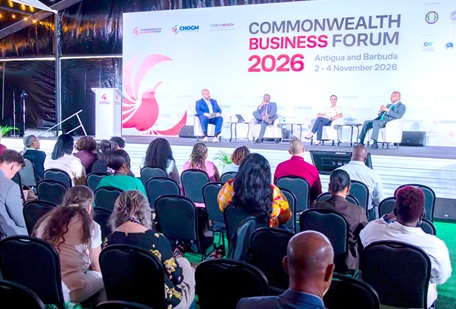
At the Commonwealth Business Forum in St. James, Antigua and Barbuda last Wednesday, Mr Ablakwa said economic integration required boldness, common rules and ambition, lessons Ghana and Africa had already learnt from the African Continental Free Trade Area (AfCFTA).
"Our full potential is still below 20 per cent, and we believe that we must ramp up and also bring on board the few countries that are yet to ratify the protocol.
"But it's clear that progress is being made; it's clear that it has led to uniform standards; it's clear that it has led to improvement in the value chain," he said.
Mr Ablakwa said African and Caribbean countries that were willing to pursue integration were already sending strong signals of their commitment.
"I see Jamaica, Barbados, Antigua and Barbuda, Trinidad and Tobago; these are countries that are signalling very strongly that they want to engage.
We are also stronger economies. Once we have the African counterparts such as Ghana, Kenya, South Africa, Nigeria, we can start, and then we commit to carrying everybody along," he said.
He reminded the forum that the African Union (AU) had designated the Caribbean Community as the sixth region of Africa.
"So, let's start with the coalition of the willing, then we can carry everybody along. We cannot wait for everybody to be ready before you take it," he said.
He cited the European Union as an example, explaining that it began with a coalition of the willing led by Germany and France, before other countries joined.
AfCFTA
Mr Ablakwa said the AfCFTA was already transforming intra-African trade in practical terms.
"We are now able to very easily receive tea, for example, from Kenya, coffee from Ethiopia, flowers from South Africa.
"They are able to receive our chocolates, cocoa, gold. So, we're seeing a lot of improvement. What Africa must now focus on is value addition.
He reaffirmed that the government of Ghana would, by 2030, no longer be exporting raw natural resources and would ensure that it added value to its resources before export.
"In gold we have already improved the situation; we are now doing 70 per cent of the refining of the gold that we export. So, these lessons can be learned."
Integration framework
Mr Ablakwa said integration must begin with the legal framework, stressing the need for established agreements and clarity on the rules to ensure their application without favouritism or discrimination.
"We must agree on uniformity in terms of the standards. And then we must challenge ourselves; we must be ambitious to set clear standards like we are doing in Ghana and then in the larger African continent," the minster stressed.
Mr Ablakwa said Africa's integration story started with regional blocs, and ECOWAS was a shining example.
"What ECOWAS achieved when ECOWAS was formed in 1975 was way ahead of even the European Union in terms of free movement, free trade and really pursuing economic integration," he said.
He said even in power supply, Ghana was able, under the ECOWAS framework, to supply electricity to countries such as Burkina Faso, Benin and Côte d'Ivoire.
