
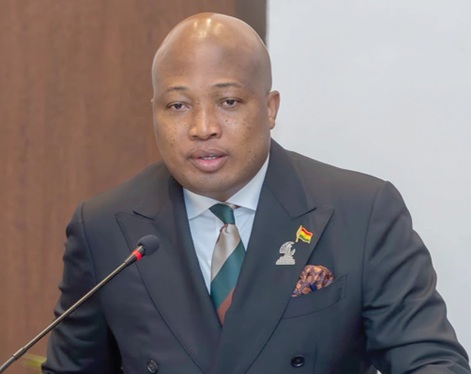
The Minister of Foreign Affairs, Samuel Okudzeto Ablakwa, has urged advocates of the proposed Fossil Fuel Treaty to build a strong, united coalition to withstand the intense geopolitics that will confront its adoption.
Speaking at a High-Level Breakfast meeting on the Fossil Fuel Treaty Initiative for Commonwealth Ministers of Foreign Affairs on the sidelines of the Commonwealth Heads of Government Meeting (CHOGM) in St. John's, Antigua and Barbuda, on Monday, Mr Ablakwa said geopolitics was unavoidable in the push for a just energy transition.
Lessons
Mr Ablakwa said campaigners for the treaty should take inspiration from the recent UN resolution on the trans-Atlantic slavery and reparations.
He recalled that despite threats and lobbying by powerful nations against the resolution, its sponsors ignored the intimidation and pushed forward after securing the required numbers.
"We were not bothered that others were issuing threats. Once we got the numbers required, we moved on, tabled the resolution, got the 123 member states to adopt it.
"Since then, we are seeing gradual consensus.
A few days ago, the UK was the latest to come on board,” the minister said.
He added that the Dutch government had also apologised for its role in slavery and presented a catalogue of 2,000 artefacts it was willing to return, while Denmark, Germany and France had also joined what he described as the growing coalition.
Reality
"You can never avoid geopolitics.
There will be competing interests.
There will be threats.
But once we are able to form a coalition of the willing, and we are not deterred and not intimidated, and we keep moving because we know our cause is just, we will eventually achieve the consensus required.
"It is not going to be an easy walk in the park.
It's going to be tough. It's going to come with, sometimes, threat of sanctions, real sanctions.
Very tough decisions will have to be made,” he said.
He acknowledged that countries like Ghana, which have enormous energy resources, face a dilemma – the opportunity to raise revenue from those resources versus the responsibility to protect the planet.
"What is the point in accumulating wealth, and then livelihoods are destroyed, and people are dying?"
Mr Ablakwa asked, and cited recent climate disasters as proof that the crisis was no longer theoretical.
"In Ghana, in June, we had the most devastating floods we have seen in over 30 years.
More than 35 lives were lost.
We saw Hurricane Melissa – the Jamaicans have told us they haven't seen anything like that in over 30 years," he said.
He also referenced recent devastation in other countries.
Coalition
Mr Ablakwa further said that the coalition must not be provocative but be able to win international support with science.
"We are going to appeal to our friends in the international community with the science.
The science is on our side.
"There are sceptics who don't want to believe, but we are all living with the effects.
From Ghana to Jamaica to Nepal.
Even Europe has recorded the warmest summer in its entire history.
You can't run away from the science. You can no longer be skeptical,” he said.
