
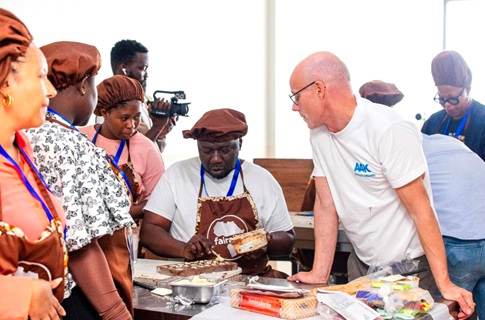
The second AAK Innovation Academy has moved from knowledge sharing to hands-on technical training, equipping 22 Ghanaian chocolate and confectionery companies with practical skills to improve product development, quality and innovation.
The two-day programme gave participants practical experience in chocolate and compound processing, tempering, tablet production, fillings and pralines, coatings, sensory evaluation, crystallisation, bloom, texture and heat stability.
The programme was built on the first AAK Academy, which was held in June 2026, and focused on industry knowledge, trends, opportunities and the use of oils and fats in chocolate production.
The second edition placed practical application at the centre, as participants worked directly with chocolate, fats and other materials under the guidance of AAK specialists, Anders Dahl Pedersen and Jan Buus Lombardi.
The academy was one of four commitments made by AAK under its Memorandum of Understanding with the Ministry of Food and Agriculture (MoFA), and was aimed at strengthening technical capacity and promoting value addition in Ghana’s food manufacturing sector.
It also formed part of AAK’s wider activities in Ghana’s agricultural value chains, including its Kolo Nafaso shea sourcing programme, which supported women shea collectors across West Africa.
Improved product quality
Speaking in an interview with the Daily Graphic, the Global Application Manager for Confectionery and Chocolate at AAK, Mr Pedersen, said the training helped manufacturers to understand how ingredients and processing affected the quality of finished products.
He said the correct use of ingredients was not enough, and stressed that manufacturers had to control the different stages of chocolate processing.
Mr Pedersen identified tempering as an important process because it affected crystallisation and the stability of the final product.
Participants also learned how to identify production challenges and how to select suitable fats and ingredients for different chocolate and confectionery products.
A participant, Kwabena Kweke of Delphi Ventures, said the training improved his understanding of tempering, fat balance and different forms of bloom.
He said the lessons had helped him to understand how to produce more stable chocolate, particularly under Ghana’s climatic conditions.
Mr Kweke said participants also learned how shea butter could be used with cocoa butter in chocolate production to improve stability.
A participant from Ab Ovo Confectionery Limited said the training provided practical knowledge on cocoa butter substitutes, including refined shea butter.
The participant said different substitutes could be used for products such as pralines and enrobed confectionery, which helped manufacturers to manage costs while maintaining product quality.
More training
The participants said the hands-on approach allowed them to apply the knowledge directly to chocolate production.
One other participant said Ghana had limited opportunities for specialised chocolate-making training, which made practical programmes such as the Academy important to local manufacturers.
The participants called for more international experts to visit Ghana to share technical knowledge with local businesses and their employees.
