
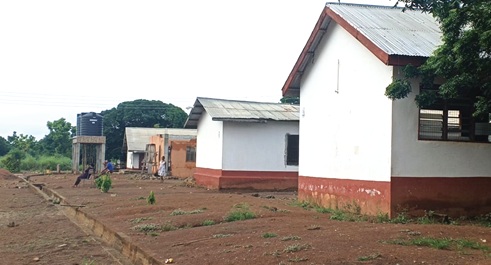
Nearly six years after the College of Community Health Nursing-Nkanchina in the Kpandai District of the Northern Region opened to train nurses for underserved rural communities, students are still studying in overstretched renovated buildings that once served as a leprosy treatment centre.
Management of the college also grapples with inadequate infrastructure, poor internet connectivity and unreliable electricity supply.
Although the institution was established by the Ministry of Health in 2020 and accredited by the Nursing and Midwifery Council (NMC), it is yet to receive a major government-funded infrastructure project to support its growth.
Outgrowing facilities
The college was established to help address the shortage of health professionals in the Eastern Corridor and the Oti enclave.
Since then, enrolment has grown steadily, but infrastructure development has not kept pace with the increasing student population.
Today, more than 500 students share limited classroom and hostel facilities.
The institution also lacks a dining hall, assembly hall and adequate washroom facilities.
Poor road access, weak telecommunications services and the absence of a school bus continue to affect teaching, learning and student welfare.
Located about seven miles from Kpandai, the district capital, the college still operates from buildings inherited from the former leprosy treatment centre.
While management has renovated some of the structures, they remain inadequate to meet the needs of the growing student population and the institution's ambitions to expand its academic programmes.
The acting Principal of the college, Joseph Kyilleh, described poor internet and mobile network connectivity as one of the institution's most pressing challenges.
According to him, weak network coverage frequently delayed official communication and disrupted online examinations, research activities, and data management.
In an effort to improve internet access, management subscribed to Starlink services. However, coverage is currently limited to parts of the campus, particularly the Information Technology (IT) and Administration blocks.
"It is frustrating to work and learn in an environment where internet and mobile network connectivity remain a challenge," he said.
Mr Kyilleh added that unreliable electricity supply had forced the college to depend heavily on a generator during examinations and other critical academic activities, placing additional financial pressure on the institution through the purchase of diesel.
Diploma
Beyond the immediate challenges affecting teaching and learning, inadequate infrastructure has also stalled plans to upgrade the institution's academic programmes.
Mr Kyilleh explained that the shortage of classrooms, hostel accommodation and laboratory facilities, coupled with the absence of a dining hall and assembly hall, continues to hinder the college's growth and delay efforts to introduce diploma programmes.
Although management is eager to move beyond certificate-level training, the institution has struggled to meet some of the requirements of the Ghana Tertiary Education Commission (GTEC) for diploma accreditation.
"Almost six years after the establishment of the college, not a single infrastructure project has been constructed and inaugurated on this campus," he said.
He appealed to the Member of Parliament (MP) for Kpandai, Mathew Nyindam, to fulfil his pledge to support the school with a classroom block and urged the Kpandai District Assembly to prioritise the institution in its development plans.
"The stakeholders in Kpandai must support the growth of this school because its growth is a gateway to development, economic expansion and trade," he said.
Students
Students who spoke to the Daily Graphic said the institution's infrastructure and service deficits continue to affect both their academic work and daily lives.
The President of the Students Representative Council (SRC), Eric Bachuri, said poor internet and mobile network connectivity regularly disrupt online examinations, research activities and virtual learning.
"Sometimes, our exams are delayed or cancelled because of poor internet and mobile connectivity.
Conducting assessments, research and data collection is difficult, and online classes are also a challenge," he said.
Mr Bachuri added that students often congregated at a few locations on campus where network signals were stronger, creating privacy concerns and making communication with relatives difficult.
He further noted that many students were compelled to travel to nearby communities to access mobile money services because of poor network coverage on campus.
Students also called for the expansion and modernisation of the Skills Laboratory, ICT Laboratory and Science Laboratory to meet the standards expected of a nursing training institution.
Sanitation and welfare concerns
The General Secretary of the SRC, Jemimah Damah Jemimah, said the absence of dining and assembly halls exposed students to harsh weather conditions during meals and school gatherings.
Students further identified inadequate sanitary facilities, poor road access and the lack of a dedicated school bus as major welfare concerns.
The Ladies Commissioner, Nayemi Princess, said inadequate toilet facilities had forced some students to resort to open defecation, exposing them to serious health risks.
She linked the poor sanitary conditions to illnesses, including typhoid fever, while other students expressed concern about snake bites in parts of the campus.
Urgent intervention
The Public Relations Officer of the SRC, Simon Nkombe Simon, appealed to the government, the Ministry of Health, and other stakeholders to urgently address the institution's infrastructure and service challenges.
He said a public health training institution that had existed for nearly six years should not still be struggling with inadequate infrastructure, transportation challenges, poor internet and mobile network connectivity, and unstable electricity supply.
According to him, improving facilities at the college would strengthen its capacity to train the healthcare professionals needed to serve rural communities across the country.
As the institution continues to battle infrastructure deficits, unreliable internet and mobile network connectivity, and unstable electricity supply, both management and students remain hopeful that government intervention will help address these longstanding challenges and position the college to introduce diploma and, eventually, degree programmes.
