
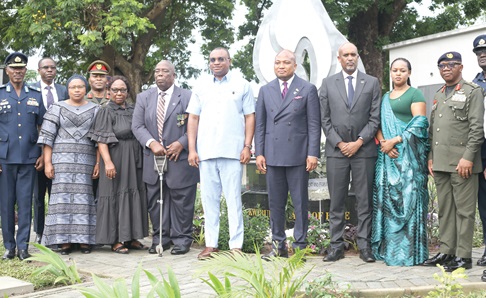
The Minister of Foreign Affairs, Samuel Okudzeto Ablakwa, has called on governments across Africa to take active responsibility in safeguarding peace, protecting human dignity and rejecting all forms of extremism and violence.
He said lessons from the 1994 Genocide against the Tutsi in Rwanda showed how unchecked intolerance, hatred, discrimination and division could lead to devastating consequences.
“The painful lessons of the 1994 genocide against the Tutsis remind us that intolerance, hatred, discrimination and division, when left unchecked for many years, can have devastating consequences,” he said.
Mr Ablakwa made the call at the commemoration of the 32nd anniversary of the Rwandan genocide which was held at the Burma Camp in Accra last Wednesday.
Ceremony
The ceremony honoured victims of the 1994 Genocide and Ghanaian peacekeepers who served in Rwanda under the United Nations.
As part of the event, Mr Ablakwa, Rwanda’s Minister of Justice and Attorney General, Dr Emmanuel Ugirashebuja, and Rwanda’s High Commissioner to Ghana, Rosemary Mbabazi, laid wreaths on the Kwibuka Flame of Hope and the Ghana Contingent Monuments at Burma Camp.
The Kwibuka Flame of Hope honours victims of the genocide, while the Ghana Contingent Monuments pays tribute to Ghanaian peacekeepers who served under the United Nations Assistance Mission for Rwanda.
Risk of mass atrocities
Mr Ablakwa urged governments to invest in strong national institutions that promoted inclusion, unity and peaceful coexistence while deliberately shaping the values of young people.
“We must, therefore, invest in strong national institutions that promote peaceful coexistence, inclusion and deliberately nurture in our young people the values of tolerance, unity and mutual respect,” he stated.
He cautioned that rising xenophobia, racism and discrimination in different parts of the world showed that the risk of mass atrocities remained.
He said the international community must confront racism and the marginalisation of minority groups if it sought to build a fair and stable global order.
“This commemoration must remind us of our collective duty as governments and citizens to champion peace, defend human dignity and reject all forms of extremism and violence,” he said.
Mr Ablakwa reaffirmed Ghana’s commitment to strengthening relations with Rwanda and deepening cooperation based on peace, mutual respect and African solidarity.
Rwadan genocide
Rwanda’s Minister of Justice and Attorney General, Dr Emmanuel Ugirashebuja, said the genocide against the Tutsi showed how long term systems of division, dehumanisation and propaganda created conditions for mass violence.
He traced how colonial policies introduced ethnic categorisation that reshaped Rwandan society and weakened social cohesion, adding that identity manipulation became a tool of political control.
He also pointed to propaganda, extremist publications and state aligned messaging that normalised exclusion and violence before 1994.
Dr Ugirashebuja said the international community failed to act decisively despite repeated warnings, describing it as a defining moral lesson for global institutions.
He said remembrance must go beyond commemoration and serve as a warning system for the world.
He paid tribute to Ghanaian peacekeepers who served under the United Nations, describing their presence as a rare act of courage during global withdrawal.
Dr Ugirashebuja warned against genocide denial and distortion, describing it as a threat to prevention efforts and historical truth.
He called for stronger cooperation between Rwanda and Ghana, and urged the international community to improve early warning and prevention systems for mass atrocities.
Gratitude
Rwanda’s High Commissioner to Ghana, Rosemary Mbabazi, expressed gratitude to the Government of Ghana, the Ministry of Foreign Affairs, the Ministry of Defence and the Ghana Armed Forces for their support in establishing the memorials.
She said the bond between Ghana and Rwanda, strengthened during the 1994 crisis, continued to grow through shared values of peace and solidarity.
The Chief of Army Staff, Major General Lawrence Kwaku Gbetanu, speaking on behalf of the Ghana Armed Forces, described the ceremony as a reflection of resilience, reconciliation and African unity.
He said Rwanda’s recovery over the past three decades demonstrated the power of national unity, reconciliation and development after conflict.
