
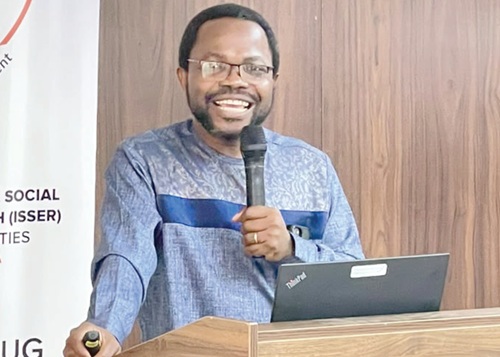
The Institute of Statistical, Social and Economic Research (ISSER) of the University of Ghana has said that the credibility of the 2027 budget will depend on which projects the government will be able to finance.
“We will judge the budget by what is paid, built and used, not by what is announced,” the Head of the Economics Division at ISSER, Prof. Fred Dzanku, said during a budget review presentation by the institute in Accra last Wednesday.
Capital expenditure
Prof. Dzanku welcomed the decision to increase capital expenditure to tackle the country’s large infrastructure deficit and unemployment, describing it as a good thing.
“Government has limited resources.
It needs to invest in certain areas.
There must be a clear prioritisation of what the needs are, so that when we are investing the resources, we will be investing them in the best possible areas that will engender the highest growth,” he said.
An amount of GH¢30 billion in capital spending is contained in the New Economy programme in a US$10 billion envelope for 2027 to 2030.
Prof. Dzanku, however, observed that delivery had historically been uneven.
In seven of the 14 years from 2012 to 2025, actual capital spending fell below the budget figures.
For instance, in 2025, the government spent about 62 per cent of what was budgeted for capital expenditure.
He, however, said there was an improvement in 2026, where about 91 per cent of capital expenditure was spent as of October.
“We need more of that. We should also make sure that we are getting value for the money spent,” Prof. Dzanku added.
He also called for a system where the public and institutions could track what was being spent, what the contracts were and what their values were, “so that it doesn’t always have to take an investigative journalist to go and dig into issues”.
Cash test
Prof. Dzanku further observed that the country could meet its surplus target and still face a cash squeeze.
Before interest, the budget projected a surplus of 0.5 per cent of GDP when new spending obligations were counted, and a deficit of 0.3 per cent when cash payments were counted.
It also sets aside GH¢13.9 billion for old bills and GH¢32.0 billion for principal repayments.
Petroleum revenue and mineral royalties account for about 63 per cent of the 2027 allocation.
“We are seeing a new economy, but its foundation is still on the old.
For instance, 63 per cent of expected revenue is supposed to be coming from minerals and oil.
“That makes it risky, because it means you are still very much exposed to external global markets,” he said.
Borrowing
On the government’s pledge of no new taxes and no borrowing from international markets despite a cash deficit of over GH¢80 billion, Prof. Dzanku said the focus should be on plugging leakages and illicit financial flows.
“If we are able to deal with the leakages in the system, if we are able to deal with the illicit financial flows, we would get enough money to be able to plug a lot of the holes,” he said.
Prof. Dzanku affirmed that borrowing was not bad if it was used efficiently.
