
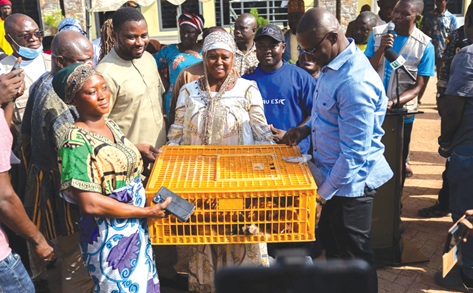
A total of 10,000 vaccinated poultry birds have been distributed to vulnerable households in the Central Gonja District in the Savannah Region under the second phase of the government’s Nkoko Nkitinkiti initiative.
The intervention, initiated by the Food and Agriculture Organisation (FAO) with funding from the European Union (EU), is expected to benefit more than 400 households by boosting local poultry production, improving household nutrition and creating income-generating opportunities.
t forms part of the EU Food Security Response in Northern Ghana Project, which earlier supported the distribution of 150,000 vaccinated poultry birds, feed and veterinary medicines to 3,000 farmers across six districts in the Savannah, Upper East and North East regions.
Ghana imports poultry products estimated at between $300 million and $400 million annually, prompting the government and other stakeholders to intensify efforts to increase domestic production and achieve self-sufficiency within three years.
Improving livelihoods
Presenting the birds, the Member of Parliament for Yapei-Kusawgu, Dr John Abdulai Jinapor, said the intervention would strengthen local poultry production and improve the livelihoods of rural households.
He said the initiative would also help address food security challenges by improving access to nutritious food and creating additional income opportunities for beneficiaries.
Dr Jinapor urged the beneficiaries to adopt good poultry management practices and develop their activities into sustainable businesses capable of supporting their families.
The FAO Representative in Ghana, Dr Meshack Malo, in a speech read on his behalf, said the first phase of the poultry distribution had reached more than 1,200 vulnerable households in six districts across northern Ghana, including Central Gonja.
He said the second phase involved the distribution of 10,000 birds, together with initial feed support, to additional vulnerable households in the district, bringing the total number of beneficiaries to more than 400.
Dr Malo urged the beneficiaries to ensure proper feeding and housing, maintain good hygiene and observe biosecurity measures to protect the birds against diseases.
He said the FAO would collaborate with the District Agriculture and Veterinary Services to provide technical support to ensure the sustainability of the intervention.
He explained that the poultry intervention complemented other agricultural support provided under the project, including improved seeds and fertilisers, agricultural threshers, moisture meters, irrigation support, groundnut and soybean processing equipment, and hermetic storage bags.
The project also provides training in good agricultural practices, soil fertility management, post-harvest handling, agribusiness and market development.
Dr Malo expressed appreciation to the EU, the government, the Savannah Regional Coordinating Council, the Central Gonja District Assembly, the Ministry of Food and Agriculture and other partners for their support.
