
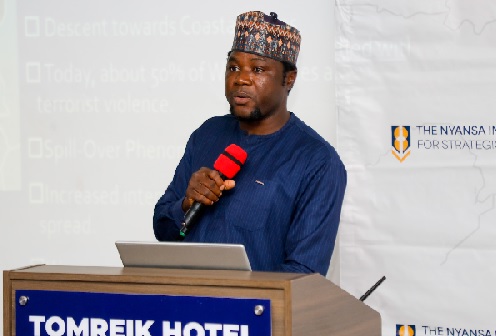
The Executive Director of the West African Centre for Counter Extremism (WACCE), Mutaru Mumuni Muqthar, has called on Ghana to take a stronger leadership role in regional efforts to contain the spread of violent extremism from the Sahel into coastal West Africa.
Speaking at the Nyansa Dialogue Series III, held under the theme “With Growing Instability Across the Sahel, How Can Ghana Help?”, Mr Muqthar said Ghana was increasingly surrounded by insecurity and could no longer treat the Sahel crisis as a distant threat.
“We are encircled by insecurity in ways that we have never seen before,” Mr Muqthar said while delivering the keynote address at the event organised by the Nyansa Institute for Strategic Dialogue in Accra last Friday.
He stated that violent extremism, once concentrated in a handful of West African countries, has expanded significantly over the past decade and now threatens the region’s coastal states.
“This threat didn't just pop up. This is something that has been with us for more than a decade. And yet, we have not succeeded in containing it.”
According to Mr Muqthar, the spread of terrorism has been accompanied by political instability, local conflicts and an unprecedented wave of military coups. He said the inability of governments to address insecurity has contributed to growing public frustration and declining confidence in democratic institutions.
He argued that Ghana’s relative stability provides it with an opportunity—and a responsibility—to help bridge growing divisions between coastal states and the military-led countries of the Sahel.
“Ghana has built a capacity and a foundation that allows us to take a leadership role in terms of addressing the friction and fractures at the regional level.”
He welcomed Ghana’s appointment of a Special Envoy to the Sahel, describing the initiative as a strategic step towards rebuilding diplomatic relations and improving intelligence-sharing with the Alliance of Sahel States.
“The office is meant to build the broader diplomatic ties between Ghana and its military-led Sahel nations.”
Mr Muqthar said the diplomatic engagement was particularly important because poor relations between neighbouring countries undermine intelligence-sharing and joint security operations.
“If you have a poor relationship with your neighbour, nobody will be willing to share information with you. They will not coordinate or collaborate with you in terms of security operations.”
He also highlighted Ghana’s role in the Accra Initiative, which was designed to prevent the spillover of terrorism into coastal states through intelligence-sharing and coordination rather than relying exclusively on military force.
However, he cautioned that Ghana’s leadership must extend beyond military and security responses. He identified youth unemployment, governance deficits, human rights abuses, marginalisation, inequality, local conflicts and resource scarcity as major drivers of violent extremism.
“The battle against terrorism, the fight against terrorism cannot be won on the battlefield.”
Instead, he said, the focus must be on addressing the conditions that encourage radicalisation and extremist recruitment, particularly among vulnerable young people.
Mr Muqthar stressed that extremist groups have become adept at understanding and exploiting the aspirations of young people, often offering them opportunities, income and a sense of belonging that they feel are unavailable through legitimate channels.
He therefore urged Ghana to strengthen its institutions and ensure that government responds effectively to the needs of citizens.
“Governance deficits and dysfunctional institutions remain one of the biggest sources of grievances.”
He also warned that the growing insecurity poses a direct economic threat to Ghana, particularly by undermining investor confidence and discouraging investment in northern communities perceived to be vulnerable to instability from the Sahel.
Mr Muqthar concluded that Ghana's contribution to regional security must combine diplomacy, intelligence-sharing, good governance, youth empowerment, economic inclusion and community resilience.
“Human security is national security,” he added
He said Ghana must seize its relative stability and diplomatic credibility to help rebuild cooperation across West Africa and prevent the Sahel's insecurity from gaining a stronger foothold in coastal states.
