
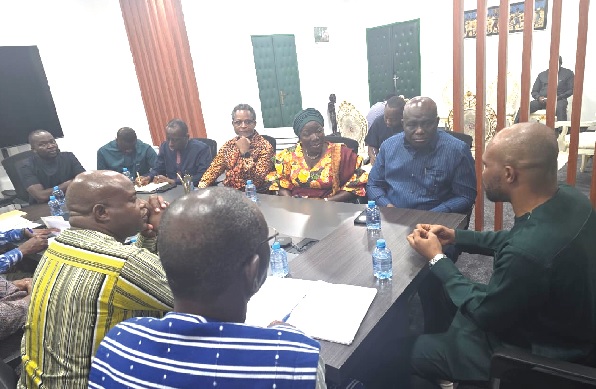
Ghana and Burkina Faso have agreed to immediately resume the export of Ghanaian eggs to Burkina Faso and the importation of tomatoes from Burkina Faso into Ghana in a major breakthrough in strengthening bilateral trade between the two countries.
The agreement follows high-level bilateral talks held in Burkina Faso last Friday, with Ghana’s Minister of Trade, Agribusiness and Industry, Elizabeth Ofosu-Adjare, and the Minister of Food and Agriculture, Eric Opoku, leading the Ghana delegation.
It secures a major trading corridor for Ghana, one considered to be of significant importance for exports.
"Ghana's exports to Burkina Faso increased from $573 million in 2024 to $637 million in 2025, underscoring the importance of the Burkina trade corridor as one of the fastest-growing in the sub-region," a joint statement released by the Ministry of Trade, Agribusiness and Industry and the Ministry of Food and Agriculture last Friday said.
The agreement secured the lifting of Burkina Faso's restrictions on Ghanaian egg exports, which had been imposed since March, as a precautionary measure over quality concerns affecting eggs from some exporting countries, particularly those originating from Dormaa in the Bono Region.
It also ensured the lifting of the ban on tomato imports from Burkina Faso into Ghana.
The joint statement indicated that the restrictions had been removed.
"The government has secured the lifting of restrictions on exports of eggs to Burkina Faso and importation of tomatoes to boost bilateral trade between the two countries," the statement said.
Assurance
The government assured poultry farmers, egg exporters and tomato importers that the engagement had yielded concrete and positive results, reaffirming President John Dramani Mahama's commitment to safeguarding the interests of Ghanaian producers and traders.
The statement said the two countries agreed to establish a joint technical committee to promptly address any trade-related concerns to prevent future trade disruptions.
It said the two sides further committed to negotiating a bilateral trade agreement aimed at strengthening economic cooperation, reducing trade barriers, and improving market access for goods and services between Ghana and Burkina Faso.
"Both governments reaffirmed their determination to ensure uninterrupted trade flows, and pledged to build on the agreement to promote economic growth and benefit traders, producers and consumers in both countries," the statement added.
Renewed partnership
It said the renewed partnership came against the backdrop of growing trade between the two neighbours.
As part of efforts to deepen commercial ties, the Trade Minister announced that Ghana would participate with a high-level delegation at this year's International Arts and Crafts Trade Fair (SIAO) in Burkina Faso, showcasing Ghana-made products and services to international markets.
The Ghanaian delegation will include Ghana's Ambassador to Burkina Faso, Sem Kenneth Akibate; officials from the Ministry of Trade, Agribusiness and Industry, and representatives of the private sector, including Agricultural Manufacturing Group (AMG) representative, Dr Ernest Appiah, and the Chairman of Dormaa Egg Exporters Association, Sylvester Asante.
Background
Burkina Faso banned the export of its fresh tomato to prioritise domestic agro-processing and secure national supplies.
The export ban went into effect in March 2026, with initial restrictions starting around mid-March and a reported enforcement date of March 16, 2026.
The decision was announced in a joint communiqué signed by the Minister of Commerce, Serge Gnaniodem Poda, and the Minister of Agriculture, Commandant Ismaël Sombié, and issued on March 16, 2026.
The directive applied across the country and covered all operators involved in the export of fresh tomatoes.
The issuance of Special Export Authorisations was suspended.
The development came after seven Ghanaian traders were killed and several others injured when armed militants ambushed them in Titao, a town in northern Burkina Faso, during a routine trip in February 2026.
The suspension severely impacted Ghanaian tomato traders and caused shortages in Ghanaian markets .
