
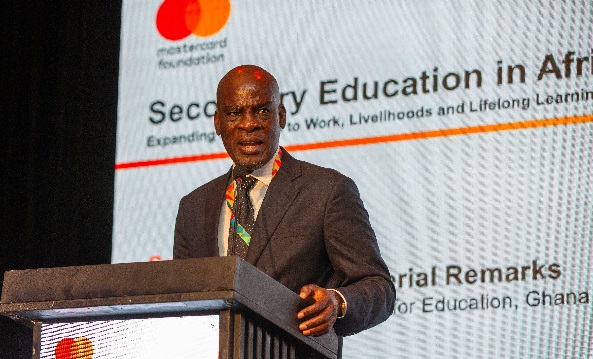
The Minister of Education, Haruna Iddrisu, has called on the Mastercard Foundation and development partners to extend their educational interventions to the Junior High School level, describing weaknesses in the sub-sector as a major contributor to quality challenges in Senior High Schools.
He says improving secondary education in Ghana requires deliberate investment in the foundational stages of learning to adequately prepare students for the demands of higher education and the job market.
Speaking at the launch of Phase Two of the Mastercard Foundation's Secondary Education in Africa Report at the Labadi Beach Hotel in Accra, Mr Iddrisu said a 2025 National Education Forum Report had identified the historical neglect of the Junior High School sub-sector as a major factor contributing to learning deficits at the Senior High School level.
He argued that the quality of secondary education could not be better than the foundation upon which it was built.
The Minister therefore urged the Mastercard Foundation and other development partners to extend successful interventions, particularly the Leaders in Teaching initiative, to the JHS level.
SHS infrastructure development
Mr Iddrisu also highlighted the need to improve infrastructure and teaching conditions in Senior High Schools, announcing that the 2027 National Budget had allocated GH¢1.37 billion towards secondary education infrastructure and the permanent elimination of the double-track system.
He said the investment was expected to provide adequate classroom space, improve access to science laboratories and ensure uninterrupted academic calendars for students.

The Minister noted that Ghana had made significant progress in expanding access to secondary education, with enrolment increasing from approximately 813,448 students in the 2016/2017 academic year to about 1.6 million between 2024 and 2026.
He attributed the expansion largely to the Free Senior High School policy, which was introduced in line with the constitutional provision for progressively making secondary education free and accessible to all.
Free sanitary pads
On inclusive education, Mr Iddrisu said government had allocated GH¢292 million in the 2027 Budget to provide free sanitary pads for schoolgirls, as part of efforts to minimise absenteeism and prevent girls from dropping out of school.
He stressed the importance of ensuring that learners with disabilities also had access to appropriate learning materials and that schools developed effective mechanisms to identify and support students at risk of dropping out.
Addressing the transition from school to employment, the Minister called for stronger collaboration among government, schools, employers and technical training institutions to provide students with career guidance, apprenticeships and entrepreneurial opportunities.
He cited the Mastercard Foundation's Young Africa Works strategy, which aims to provide three million young Ghanaians with access to dignified and fulfilling work by 2030, with young women accounting for 70 per cent of the target.
Mr Iddrisu challenged African Ministers of Education attending the continental launch to identify at least one major barrier to secondary education and commit to addressing it within the next 12 months.
He urged participating countries to establish clear accountability mechanisms, mobilise the necessary resources and involve teachers and young people in monitoring the implementation of reforms.
The Mastercard Foundation's Secondary Education in Africa Report, Phase Two, focuses on expanding pathways from secondary education to employment, sustainable livelihoods and lifelong learning across the continent.
