
The Director of the Institute of Applied Science and Technology at the University of Ghana, Professor Samuel Kojo Kwofie, has described cybersecurity as one of the greatest threats to the digital space, calling for a new generation of African experts to develop home-grown initiatives to address emerging cyber threats.
He said addressing the growing challenges associated with cybersecurity and artificial intelligence required stronger collaboration among African institutions, researchers and students, guided by the African philosophy of Ubuntu — the principle of shared humanity, mutual responsibility and collective progress.
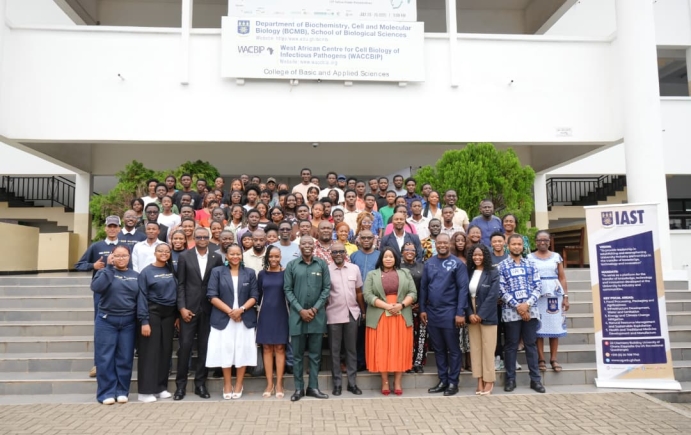
Professor Kwofie made the remarks at the opening of a two-day Pan-African Student Workshop on Digital Ubuntu, Cybersecurity and AI, organised by IAST in partnership with Nelson Mandela University, South Africa, at the West African Centre for Cell Biology of Infectious Pathogens at the University of Ghana in Accra. The workshop, the first of its kind in Ghana, attracted more than 250 participants, including university deans, directors, heads of departments, faculty members, industry players and students from Ghana and South Africa.
Professor Kwofie said the initiative emerged from discussions between colleagues at the two universities and reflected their shared commitment to strengthening institutional partnerships and equipping students with practical skills to address Africa’s technological challenges. He called for deliberate investment in training young Africans to anticipate, understand and respond to emerging cybersecurity threats while using AI responsibly to support community development.
Cross-border collaboration
The co-convenor of the workshop and leader of the Digital Ubuntu Seminar Series at Nelson Mandela University, Dr Bukelwa Ngoqo, emphasised the need for African countries to work together on digital Ubuntu, AI and cybersecurity. She highlighted the importance of cross-border collaboration in developing technological solutions that respond to Africa’s realities and priorities.
Welcoming participants, the Director of the University of Ghana’s Research and Innovation Directorate, Professor David Dodoo-Arhin, underscored the role of student-centred initiatives in driving innovation. He encouraged participants to harness Africa’s collective resources, knowledge and expertise to develop home-grown technological solutions, while building professional networks that could support future research and innovation.
The Dean of the School of Engineering Sciences at the University of Ghana, Ing. Professor Elsie Effah Kaufmann, said the workshop aligned with the University’s five strategic priorities by equipping students with future-ready skills and promoting interdisciplinary research and international partnerships.
Strengthened institutional ties
From Nelson Mandela University, the Director of Research Support and Management, Dr Palesa Mothapo, highlighted the significance of the renewed Memorandum of Understanding between the two institutions. She said the agreement places emphasis on measurable research outcomes in areas including AI, entrepreneurship and student mobility.
The Head of the Department of Computer Engineering at the University of Ghana, Professor Robert Adjetey Sowah, noted that cybersecurity threats transcend national boundaries and therefore require coordinated responses from researchers and institutions across Africa. He also encouraged faculty members to explore emerging funding opportunities in AI and cybersecurity research.
The Senior Research Assistant at IAST, Dennis Dickson, emphasised the need for more such AI workshops for students and called on industry to support the institution in its quest to regularly train students in emerging technologies. The Administrator of IAST, Mrs Elfreda Bansah, and a Research Development Officer at RID, Mrs Amma Afumwaa Appah, who both played key organisational roles in the workshop, called for continuous collaborations between international institutions to co-design top-notch AI training with transnational dimensions.
AI presents opportunities and risks for Africa
Technical sessions led by representatives of Nelson Mandela University examined AI governance, cybersecurity and digital inclusion, with speakers stressing the need for African countries to develop national AI strategies grounded in transparency, data privacy, accountability and safety.
A major highlight of the workshop was a student panel discussion titled "AI from an African Perspective," featuring students from the University of Ghana and Nelson Mandela University. Panellists agreed that AI could transform critical sectors such as healthcare, agriculture and education. However, they stressed that Africa’s ability to benefit from the technology would depend on investment in local data, digital infrastructure and skills development.
