
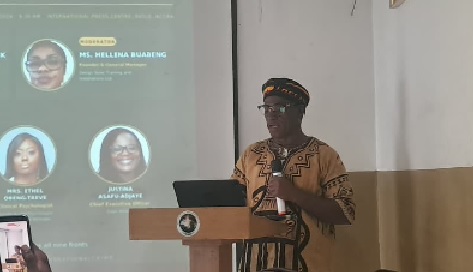
A new body, Civil Society Coalition Against Transnational Crime, has been launched in Accra with a call for stronger collaboration among government, civil society, traditional authorities, communities and the private sector to tackle the growing threat of organised crime in Ghana.
The coalition, launched today in Accra to mark International Youth Day, seeks to coordinate civil society organisations working across nine fronts, including human trafficking, cybercrime, illicit finance, illegal mining, drug trafficking, weapons trafficking, maritime crime, extremism and corruption.
The initiative follows a national forum held on July 30, 2026, dubbed “Trapped Behind the Scam”, which brought together government institutions, the United Nations, civil society groups, survivor networks, financial and technology sectors, academics, the media and young people to discuss the growing incidence of trafficking for forced criminality.
At the launch, the Convener of the coalition, Princess Yanney, said the initiative was born out of the need to ensure that people rescued from trafficking situations were properly identified and supported rather than automatically treated as criminals.
She referred to the rescue of nine people and the arrest of 10 suspects at Afienya on July 21, 2026, saying the incident raised questions about what happened to those rescued.
“Was anybody assigned to them? Was there a file? Did anyone sit down with each of them and ask the questions that determine whether a person has been trafficked?” she asked.
Princess Yanney said the coalition would establish a register of its founding members and nine working groups, with each group responsible for engaging relevant institutions on a specific area of organised crime.
She said the coalition would also operate under a charter requiring members to uphold safeguarding, ethical conduct and conflict of interest standards.
“We are one Coalition working nine fronts of a single economy,” she said, explaining that the different forms of organised crime were often interconnected.
The Chairman of the occasion, Professor Caesar Apentiik, said organised crime was no longer an abstract security concern but an entrenched and evolving threat that required urgent collective action.
He cited the 2025 Global Organised Crime Index, which placed Ghana's criminality score at 5.77 out of 10, ranking the country 21st out of 54 African countries and sixth out of 16 in West Africa.
He said the figures reflected serious concerns, including human trafficking, cyber-dependent crime, cocaine trafficking and crimes involving non-renewable resources.
“Organised crime in Ghana is no longer an abstract threat discussed in the media or security briefing. It is here with us, and it is entrenched,” he said.
Professor Apentiik said civil society had an important role to play because its organisations were often closer to communities where criminal networks recruited young people and vulnerable persons.
He stressed that the coalition was not intended to replace the state but to complement government efforts, provide community intelligence and demand accountability where necessary.
“Civil society leadership in this state is not about replacing the state. It is about complementing it, challenging it when necessary, and holding the state accountable,” he said.
The Head of Programmes at the Ghana Red Cross, Jeremiah Afako, said the fight against transnational crime must remain centred on people, particularly young people who were vulnerable to trafficking, exploitation and other forms of organised crime.
He said the Ghana Red Cross, through its volunteers and community networks, would contribute through community awareness, youth engagement, protection, referrals and efforts to strengthen community resilience.
“Behind every case of trafficking or exploitation is a person, a family and a community whose lives can be deeply affected,” he said.
Mr Afako urged stakeholders to see young people not only as vulnerable persons but also as partners in preventing exploitation and organised crime.
Guest of honour for the launch, HRM Togbe Adze II, also called for closer collaboration between traditional authorities, communities and state institutions.
He said many young people were lured through fake job advertisements, only to have their passports seized and be forced to engage in online fraud under threats.
He cautioned young people against suspicious employment offers, saying, “A real employer does not take your passport. A real employer does not charge you a fee to be hired. A real employer does not need you to travel to act.”
Togbe Adze II also urged the coalition to work directly with traditional authorities and communities instead of relying mainly on workshops and conferences.
He said communities often possessed valuable information about young people who had travelled under suspicious circumstances or returned from trafficking situations.
“We know which families have someone away, we know when money has appeared without explanations. That knowledge is worth more than your workshops and it is free,” he said.
