
Civic Response, a natural resource governance advocacy organisation, has begun a nationwide training programme for nearly 1,000 Social Responsibility Agreement (SRA) committee members from 150 forest fringe communities to help them detect and prevent the diversion of timber royalties meant for their communities.
The training, being held in batches of 40 to 50 participants from July to October 2026, is being delivered under the project, “Enhancing SRA Implementation in Ghana’s Forestry Sector,” with support from the European Union’s FLEGT Programme.
Speaking at a training session on Thursday, August 13, 2026, the Head of Programmes at Civic Response, Mr Albert Katako, said the training was aimed at helping communities understand their rights and responsibilities under the law, as well as those of other stakeholders in the forestry sector.
He said the training would enable communities to recognise when their rights were being violated and understand the options available to them in seeking redress.
“When we started, the main comments from the communities were that we’ve been cheated for far too long. Now we know exactly what to do,” Mr Katako said.
He said the programme started in 2017 and that communities that returned for follow-up sessions had reported that timber companies were increasingly fulfilling their obligations.
Trainers took participants through the SRA negotiation process, from pre-negotiation to documentation, as well as the legal basis for SRA payments.
The payments are fixed at five per cent of stumpage fees paid by timber companies to communities within a five kilometre radius of logging operations.
The training also covered the composition and conduct of SRA committees. Such committees should have no fewer than five and no more than seven members drawn from different community interest groups, with adequate gender representation. Members serve two year terms.
A community chief, or the chief’s representative, is not allowed to serve as chairman or financial secretary of an SRA committee. Mr Katako said communities themselves proposed the restriction during consultations on the training curriculum.
On financial accountability, trainers taught participants how to keep receipts for every purchase, maintain expenditure and budgeting records using standard templates, and report to their communities every quarter.
They also learnt basic procurement procedures, including comparing prices from at least three sources before making purchases.

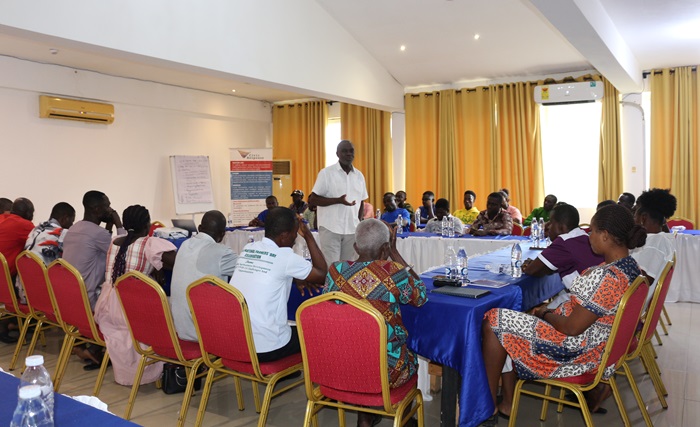
A section of participants during the SRA committee members’ training
To help communities verify whether timber companies comply with their logging permits, trainers explained the technical processes involved in timber harvesting.
These included how logs and tree stumps are marked with matching codes, the permitted hours for transporting logs, which are from 6 a.m. to 6 p.m. on working days, and the requirement for written permission for weekend transportation.
Participants also learnt about the boundaries of protected buffer zones along rivers and streams, where logging is prohibited.
Mr Katako encouraged communities to use mobile phones to document and report suspected illegal logging to the Forestry Commission instead of confronting operators themselves.
He stressed that reports should be based strictly on activities defined as illegal under the law.
Mr Katako said Civic Response had identified a discrepancy between the estimated value of SRA payments communicated to communities before logging and the actual amount due after timber volumes had been measured.
He said the organisation had raised the issue with the Forestry Commission, which had “taken note” of it and was working to ensure that accurate figures were posted in future to reduce disputes.
Mr Katako also commended the Forestry Commission for a system that requires timber companies to pay their SRA obligations upfront before logging begins.
He said companies that failed to comply risked losing their FLEGT export licence, which he described as central to Ghana’s timber trade with the European Union since full enforcement began in August 2025.
He added that the wider aim of the training was to improve governance in the forestry sector in a manner that benefits timber companies, the Forestry Commission and forest communities.

Participants and facilitators in a group photograph after the training session
The nature of the problem the training seeks to address was illustrated by Mr Hayford Duodu, chairman of the SRA committee for the Jomoro community in the Western Region.
Mr Duodu told the session that a central committee representing only a few of the 12 fringe communities entitled to a share collected SRA cheques for the Tano Anwia Forest Reserve.
He said the arrangement made it difficult for most of the communities to verify the amounts collected and distributed.
“When you go to the bank for the statement, they will tell you, you are not a beneficiary to the central committee, so you are not supposed to see it,” Mr Duodu said.
He said the training had equipped him with the knowledge to request bank statements directly and, where necessary, invoke Ghana’s Right to Information Act to obtain the information.
