
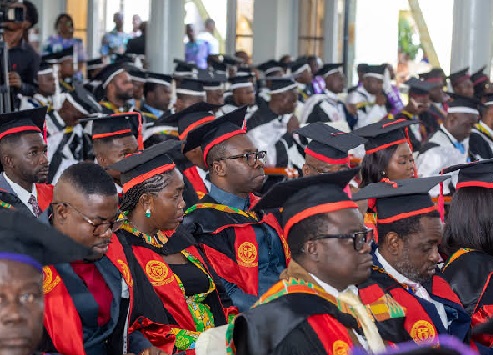
Acting President of Trinity Theological Seminary, Rev. Prof. Samuel Ayete-Nyampong has called for a renewed commitment to Christian values, including integrity, servant leadership, compassion, diligence and unity, to address Ghana's socio-economic and governance challenges.
Delivering a welcome address at the seminary's 81st Graduation Ceremony in Accra last Saturday (November 14, 2026), he said Ghana's development required more than sound economic policies, infrastructure and skilled labour, stressing the need for moral transformation and responsible leadership.
Speaking on the theme, “Leveraging Christian Values for Ghana's Development,” Rev. Prof. Ayete-Nyampong identified corruption, declining public trust in institutions and social exclusion as major obstacles to national development.
He cited Ghana's score of 43 out of 100 on the 2025 Corruption Perceptions Index, arguing that corruption undermined public confidence and diverted resources from critical sectors such as education, healthcare and infrastructure.
“In Christianity, leadership is a sacred trust, not a pathway to privilege. And so a godly leader will ask, whom am I serving, rather than what can I gain in serving,” he stated.
Graduation
A total of 325 students graduated after completing their respective programmes of study and passing the requisite examinations to qualify for the academic awards.
The graduands received awards in the Certificate in Ministry (CIM), Diploma in Theology (Dip Theo), Bachelor of Theology (BTh), Master of Arts in Ministry (MAM), Master of Divinity (M.Div.), Master of Arts in Theological Studies (MATS), Master of Theology (MTh), Doctor of Ministry (D.Min.) and Doctor of Philosophy in Theology (PhD) programmes.
It brought together members of the seminary's Governing Council, heads of churches, management, members of the clergy and the ecumenical community, government representatives, representatives of partner institutions, traditional leaders, faculty members, parents and guardians.
Notable dignitaries included the Chairman of the Governing Council, Rt. Rev. Lt. Col. Dr Bliss Divine Agbeko (Rtd.), General Secretary of the Christian Council of Ghana, Rev. Dr Cyril G. K. Faysi, who represented the Guest of Honour, Member of Parliament for Ho Central, Emmanuel Kwasi Bedzrah, Vice President of the seminary, Very Rev. Prof. Mark S. Aidoo, Chaplain, Very Rev. Dr John Abedu Quashie, Principal of EP Seminary, Rev. Dr Daniel Sackitey, Member of Parliament for Assin South, Rev. John Ntim Fordjour and Founder of Maranatha Power Ministries, Bishop Afotey Odai.
Greater protection
Rev. Prof. Ayete-Nyampong also called for greater protection of vulnerable groups, particularly struggling families, children, persons with disabilities and marginalised communities.
He condemned harmful cultural practices, including the wrongful accusation and abuse of older women over allegations of witchcraft.
Addressing the Church's responsibility in national development, the Acting President urged Christian leaders to demonstrate integrity and consistency in their own conduct.
He expressed concern about public disagreements among pastors and prophets on social media, describing the development as damaging to Christianity's image in Ghana.
He consequently appealed to the Christian Council of Ghana, the Catholic Bishops' Conference, and the Christian and Pentecostal Council to collaborate in resolving the disputes.
“We cannot credibly condemn public corruption while tolerating malpractices within the Church and bitter animosity between Christians,” he cautioned.
“The greatest contribution Christianity can make to national development is not merely the number of Christians in the nation, but the quality of Christian character demonstrated in the lives of the nation,” he said.
The Acting President appealed to the government, sponsoring churches, alumni, institutional partners and friends of the seminary to support infrastructure development.
He identified shortages of staff accommodation, delays in the proposed GetFund Student Hostel project, and the need to renovate existing residential facilities as major institutional challenges.
He said adequate accommodation was essential for staff welfare, student well-being and effective residential theological formation.
Charge to graduands
Addressing the graduands, Rev. Prof. Ayete-Nyampong urged them to make character and service central to their professional and ministerial lives.
He challenged them to uphold what he described as the four Cs: conviction, confidence, compassion and courage.
He encouraged them to defend truth, pursue lifelong learning, respond to the needs of vulnerable people and confront injustice, even when doing so came at a cost.
“Your qualifications are a significant achievement, but your character will be your enduring legacy,” he told the graduands.
Keynote address
Delivering the keynote address on behalf of the Guest of Honour, Board Chairman of the Ghana Education Trust Fund (GETFUND) and Member of Parliament for Ho Central, Emmanuel Kwasi Bedzrah, the General Secretary of the Christian Council of Ghana, Rev. Dr Cyril G. K. Fayosi called for stronger collaboration between the Church and the State to promote ethical leadership, moral development and national progress.
He said Ghana's development must go beyond economic growth, infrastructure and technological advancement to include the building of people, strengthening of institutions and cultivation of moral values.
Rev. Dr Fayosi said values such as integrity, honesty, accountability, diligence, compassion, justice and humility were essential ingredients for nation-building.
“A nation may make significant investments in physical infrastructure and economic development, but if it neglects the moral and ethical formation of its people, its progress remains fragile,” he stated.
He observed that Ghana continued to grapple with corruption, greed, intolerance, abuse of authority, social fragmentation and declining public trust, making the role of theological institutions in nurturing ethical leadership increasingly important.
According to him, theological education should not be viewed solely as preparation for ordained ministry but as an important tool for the intellectual, ethical, spiritual and moral formation of society.
“We must, therefore, regard investment in theological education as an investment in the moral and social infrastructure of our nation,” he emphasised.
“The Church must not only preach righteousness, it must model righteousness,” he said.
Charges graduates to become agents of transformation
Addressing the graduands, he urged them to measure the value of their education not merely by the qualifications they had acquired but by their contributions to society.
“The true value of your education will ultimately be measured not simply by the qualifications you acquire, but by the lives you have. The difference makes the difference,” he told them.
Award winners
The awards recognised students who distinguished themselves in various academic programmes and areas of theological education, including ministry, Christian leadership, pastoral ministry, ecumenism and African Christian theology.
Among the top award recipients were Harriet Akua Ofori Amoako, Richard Odei and Christina Brobbey-Quaye, who jointly received the Best Student Awards in the Certificate in Ministry programme.
Joseph Kanda was named Best Student in the Bachelor of Theology programme, while Sally Aidoo received the award for Best Student in the Master of Divinity programme.
In the Master of Arts in Ministry programme, Irene Schandorf Entsi and Kusi Ernest were jointly recognised as the best students.
Julius Glorifilled-Christlord and Maxwell Johnson Obodai Sai also shared the Best Student Award in the Master of Theology programme.
David Akume Denu and Michael were named Best Students in Ecumenism.
Other special award recipients included Joseph Kanda, who received the H.C. Allotey Award for Best Student in Law for Pastoral Ministry, while Evelyn Owusuaa was honoured as the Best Female Ministerial Student.
David Akume Denu received the Emmanuel Asante Award for Best Student in Church and Society, while Edward Asante Afuaka and Raphael Edwin Madison jointly received the Emmanuel Amartey Award for Best Student in African Christian Theology.
Paul Tei was named recipient of the J.O.Y.M.T. Award for Best Student in Ethics and Christian Leadership while the William Ofori Atta Award for Best Student in Holistic Ministry went to Ishmael Oduro.
