
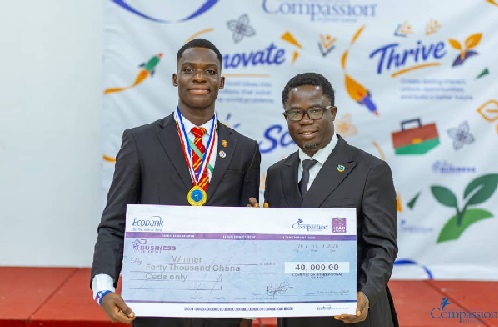
Eighteen-year-old University of Cape Coast student, Sabi Emmanuel, has emerged winner of Compassion International Ghana's 2026 Business Challenge with his waste management venture, Sabi Bottles, earning a GH¢40,000 cash prize to expand the business.
Emmanuel, a Level 200 Bachelor of Commerce (Finance) student, impressed judges with his innovative approach to tackling plastic waste through the collection, sorting and supply of discarded plastic bottles to recycling companies.
His business, established on March 4, 2025, works with community institutions to collect discarded bottles, which are sorted, packaged and supplied to recycling buyers. Revenue generated depends on the quality and quantity of bottles collected and prevailing market prices.
Presenting his business at the final pitch competition in Accra on Friday, November 20, Emmanuel said the venture was designed to transform plastic waste into an economic resource while contributing to environmental sustainability.
"We don't want to see plastic bottles as waste with no value. We see them as a resource waiting for an opportunity. We are not waiting to own a recycling factory before making a difference. We are starting with what we have and working towards what we want to become," he said.
He explained that Sabi Bottles currently collects approximately 2,000 kilogrammes of discarded plastic bottles monthly, generating an estimated revenue of GH¢3,000 and a gross profit of GH¢1,400 after operational costs.
Emmanuel said the business intended to reinvest its earnings and prize money into acquiring a recycling machine and a tricycle to improve collection and transportation.
Long-term vision
He disclosed that the long-term vision was to move beyond collecting and supplying plastic bottles to manufacturing useful products such as pavement blocks, tiles, bucket trays and flowerpots from recycled materials.
The young entrepreneur said the business aimed to acquire its first recycling machine within the next two years and gradually expand its production capacity.
He identified the inconsistent supply of plastic bottles as one of the major challenges facing the venture but expressed confidence that increased collection volumes and investment in equipment would improve its operations.
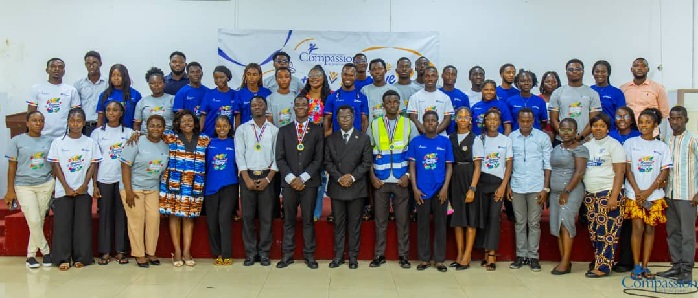
Emmanuel also highlighted the environmental significance of the initiative, particularly in addressing plastic pollution and flooding, which he said had become visible challenges in communities across the country.
"Our forefathers fought for a free Ghana. Today, we have another responsibility to protect the Ghana they left for us and build the Ghana we want for generations yet to come. Let's honour their legacy by keeping our motherland clean," he said.
He called on individuals, institutions and potential partners to support Sabi Bottles in its mission to promote a cleaner and more sustainable environment.
Runners-up
The first and second runners-up of the Challenge = Louis Oteng Antwi and Adotey James Brown, who received GH¢30,000 and GH¢20,000 respectively, outlined their entrepreneurial ambitions, highlighting how their businesses seek to address environmental challenges while creating economic opportunities.
the first runner-up, Louis Oteng Antwi, a 21-year-old final-year Environmental Science student at the Kwame Nkrumah University of Science and Technology (KNUST), is using his passion for environmental sustainability to develop an innovative agricultural waste recycling business.
His venture, OA Mushroom Farms and Compost, focuses on converting agricultural waste materials, including sawdust, into useful products such as compost, mushrooms and mushroom substrates.
He explained that the initiative seeks to address environmental pollution while promoting sustainable agricultural practices and creating employment opportunities for young people.
"What we do is that we convert agricultural waste like sawdust into compost, mushrooms and mushroom substrates," he said.
According to him, the business is driven by his desire to contribute to environmental protection through the productive reuse of materials that would otherwise become waste.
"With these, we tend to clean up the environment, reduce pollution and also create green jobs for younger people such as myself," he stated.
Antwi said his academic background and personal interest in Environmental Science had significantly influenced his decision to venture into composting and agricultural waste processing.
He described himself as someone who enjoys transforming one product into another, a passion he said aligns with the principles of sustainability.
"The reason why I am doing this is because of the love I have for Environmental Science and the background I have. I tend to like to do alchemy, change one product to another. I also think it's part of the sustainability lifestyle I live. That's why I'm doing this," he explained.
Antwi received GH¢30,000 as the first runner-up, which he intends to invest in strengthening the distribution capacity of his business.
He disclosed that acquiring a tricycle or a similar means of transportation was among his immediate priorities, as it would enable him to distribute his products more efficiently and reach a wider customer base.
"I think it would help me do distributions. I'm planning on getting a tricycle or something for distribution. That would help me reach out to lots of people and increase my numbers," he said.
His plans reflect a commitment to expanding the reach of OA Farms and Compost while increasing the impact of its waste-to-resource model.
Adotey James Brown, a 20-year-old Accounting and Finance student at Accra Technical University, emerged as the second runner-up with his waste collection business, which seeks to address challenges associated with the reliability and trustworthiness of waste collection services.
As the second runner-up, Brown received GH¢20,000 in cash.
He added that observing some of these challenges while working with his uncle motivated him to develop a business that could offer solutions to the problems.
"My business was birthed out of experience with my uncle," he noted.
Brown described his participation in the competition as an exciting but challenging journey, particularly given the successive rounds of elimination that reduced the number of contestants from 80 to the final group of 15.
Reflecting on his progress, he said he was encouraged by the opportunity to make it through the various stages, although the pitching sessions required considerable confidence and preparation.
He recalled being surprised when he topped the list of contestants following an initial pitching session, but acknowledged that the competition remained unpredictable.
"We came here, and on the first day after the pitch, they gave us the results. I was first on the list. I was like, wow, what did I even do? But it's a game," he said.
He also spoke about the pressure of pitching before an audience, explaining that standing before a room full of people and communicating his business idea was initially intimidating.
"You feel a bit nervous trying to explain to people about what you do. Looking at the crowd, people watching you, everywhere is silent. Every focus is on you. How am I going to talk to them about something I do?" he recounted.
He, however, expressed optimism that the prize money would provide a starting point for his entrepreneurial ambitions, stressing that the difference between his initial funding request and the amount received would not prevent him from pursuing his plans.
"That doesn't mean that I cannot start a business," he said.
He disclosed that he had already contacted his mentor and intended to seek further guidance from experienced business leaders, particularly Madam Leticia, to help him determine the best way to develop the venture.
He said the experience and expertise of established entrepreneurs would be valuable in guiding his next steps.
Both entrepreneurs demonstrated how practical solutions to environmental challenges can be transformed into viable business opportunities, with their respective ventures focusing on improving waste management, promoting sustainability and creating opportunities for young people.
Their achievements at the 2026 Compassion International Ghana Business Challenge provide a platform for the further development of their businesses through the financial support, mentorship and entrepreneurial exposure offered by the competition.
The remaining 12 participants each received GH¢10,000 to support their businesses, bringing the total financial support to GH¢220,000.
Business Challenge
The Manager of Programmes Support in charge of Youth Development at Compassion International Ghana, Rashida Idrissa, said the Business Challenge was introduced to address the difficulties young people encounter in sustaining businesses after receiving startup kits and equipment.
Representing the National Director, Mr Kobena Okyere, she explained that the organisation's experience had shown that providing young entrepreneurs with tools to establish businesses was not enough, as many continued to face challenges that sometimes forced them to abandon their ventures.
"The Business Challenge is an intervention we initiated after several years of trying to support young people with business startup kits to go into businesses. Through our learning, we observed that though we provide all these tools and equipment to support them to begin, there are still a lot of bottlenecks these young people face. As a result, some even give up on these businesses," she said.
According to Mrs Idrissa, the second cohort was therefore designed to provide more structured support through business training, mentorship, institutional partnerships and financial assistance.
The programme began in April 2026 with a call for applications and included a business idea competition, a partners' forum and training sessions facilitated by LEAD Africa, an implementing partner.
Participants were also assigned experienced business mentors to guide them in refining their business concepts, developing sustainable business models and improving their pitching skills.
She said the initiative brought together relevant institutions, including the Ghana Enterprises Agency and the Office of the Registrar of Companies, to provide guidance and support to the young entrepreneurs.
Judges
The competition was adjudicated by a panel comprising mechanical engineer Nana Ama Tima Boakye, Chief Executive Officer of Cubica ENERGY, Leslie Arthur, and lawyer and Lead Consultant at Cital Legal Consult, Kezia Kenneth Azumah.
Also in attendance were a representative of the Ghana Enterprises Agency (GEA), Juliana Bemah Adubofour and Co-founder and Executive Director of Lead Afrique International, Leticia Ohene-Effah.
