
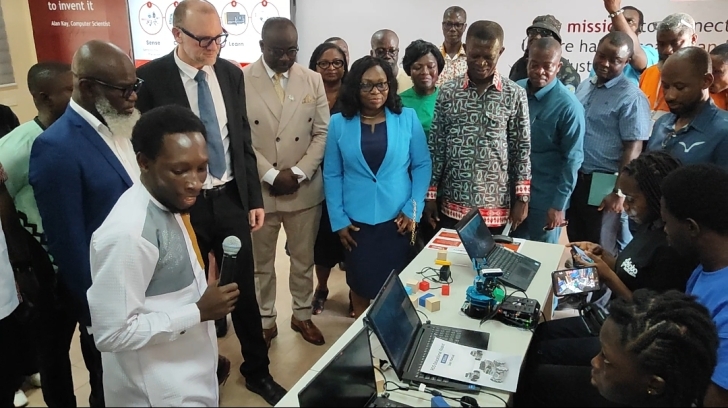
The University of Mines and Technology (UMaT), Tarkwa, has opened a €400,000 Robotics and Automation Laboratory, known as RobotechLab, to strengthen practical skills development, promote technological innovation and bridge the gap between academic training and industry requirements.
The facility, established at the university's Department of Computer Science and Engineering, is the outcome of a strategic partnership between UMaT, IBES AG and the German development agency, GIZ.
Speaking at the opening ceremony, the Vice-Chancellor of UMaT, Professor Bernard Kumi-Boateng, said the initiative marked an important milestone in the university's efforts to advance technological innovation and equip students with relevant skills to thrive in an increasingly technology-driven world.
He said the laboratory was established in response to the growing global demand for skilled professionals in robotics, automation and other ICT-driven technological fields. The project has an estimated value of more than €400,000, jointly funded by GIZ and IBES AG, while UMaT made an in-kind contribution valued at more than €50,000, comprising laboratory space and other institutional resources.
Professor Kumi-Boateng disclosed that the university had selected approximately 20 lecturers and staff from various departments to participate in a training-of-trainers programme facilitated by IBES and its German partners. The programme is expected to equip the personnel with the competencies to develop and deliver robotics curricula, undertake research and offer professional short courses at the laboratory.
He said the facility would serve as a platform for translating academic knowledge into practice, strengthening interdisciplinary research and deepening collaboration between the university and industry. He noted that the initiative aligned with UMaT's efforts to introduce innovative and industry-relevant academic programmes that respond to emerging technological trends.
Professor Kumi-Boateng expressed appreciation to GIZ and IBES for their investment, as well as the university's staff and the Department of Computer Science and Engineering for their contributions.
The Project Manager of GIZ develoPPP, Resal Saberi, said the laboratory represented an investment in people, practical knowledge and stronger connections between education and the world of work. She noted that the initiative sought to address the challenge of ensuring that knowledge acquired in educational institutions translated into practical skills and employment opportunities.
She observed that robotics, automation and digital technologies were transforming industries globally, but stressed that technological advancement alone could not drive development without people equipped to understand, operate and maintain those technologies.
"The RobotechLab will provide students and professionals with opportunities to gain hands-on experience in ICT-based robotics and automation, helping them strengthen their competencies to respond to the changing labour market," she stated.
Ms Saberi explained that the project was supported by the German Federal Ministry for Economic Cooperation and Development (BMZ), implemented by GIZ through its develoPPP programme, in partnership with IBES AG and UMaT. She said IBES AG brought private-sector and technology expertise, UMaT provided the academic environment, while GIZ facilitated the partnership to promote sustainable development outcomes.
She, however, cautioned that the success of the laboratory would depend on how effectively it was used to support practical learning, innovation and industry collaboration. She challenged students and professionals to take advantage of the facility to experiment, develop solutions and acquire skills applicable to the workplace, while encouraging businesses to engage with the university to identify practical challenges and support relevant training opportunities.
