
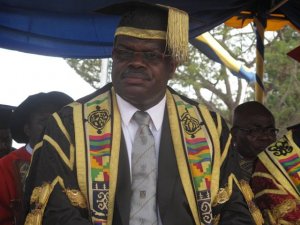
 The Vice Chancellor of the University of Ghana, Legon, Professor Ernest
Aryeetey, has criticized successive governments for their casual
treatment of discussions for educational reforms and the relationship
between education and national development.
The Vice Chancellor of the University of Ghana, Legon, Professor Ernest
Aryeetey, has criticized successive governments for their casual
treatment of discussions for educational reforms and the relationship
between education and national development.
He was speaking at the University’s Congregation organized in Accra
where 2,573 students were awarded various degrees, diploma and
certificates.
Prof Aryeetey said: “I am concerned that the funding of different types
and levels of educational institutions does not appear to be inspired by
any clear strategy towards the long term transformation of the national
economy and society.”
He expressed concern that discussions on how the school system could be
restructured including issues of access and curriculum, and how these
could be related to the tertiary system, was done in small groups
without any reference to the broader set of stakeholders.
According to him, the absence of consensus on the way forward meant that changes were not sustainable.
“The fact that many of the graduates leaving these grounds today will
not be finding jobs for a long time should oblige us, as a people, to
think about education in a more structured way and much more
strategically,” he said.
He announced that management had decided to decentralize the
University’s structure and had proposed the adoption of a collegiate
model.
This reform is to enhance efficiency and to make the University
administration very effective.
Prof Aryeetey added that it would provide greater opportunity to
students with respect to programme offerings and to enhance
inter-disciplinary research.
Consequently, management had appointed University Structure Reform
Committees to oversee the development or reorganization of four
colleges.
The proposed colleges include College of Health Sciences, College of
Basic and Applied Sciences, College of Humanities and College of
Education.
Prof Aryeetey hinted that work towards the design of the new colleges is expected to be completed by 31st March 2013.
He also announced that plans were afoot for the University to roll out
its restructured four-year Doctor of Philosophy programme in January
2013.
Key aspects of the programme include compulsory course work, attachment
to research projects for all candidates, the introduction of
comprehensive examinations to be taken by all PhD candidates and the
formal defense of the candidate’s research proposal.
These modifications are aimed at making PhD graduates perform better in
research methodology, show better understanding of data collected, use
more current and sophisticated analytical techniques and draw more
credible conclusions from their work.
He therefore advised the graduates to apply themselves to hard work, dedication, honesty and independent thinking.
Source: GNA
