
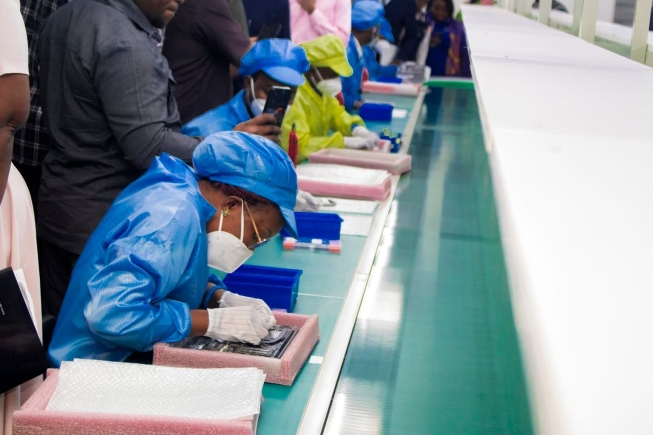
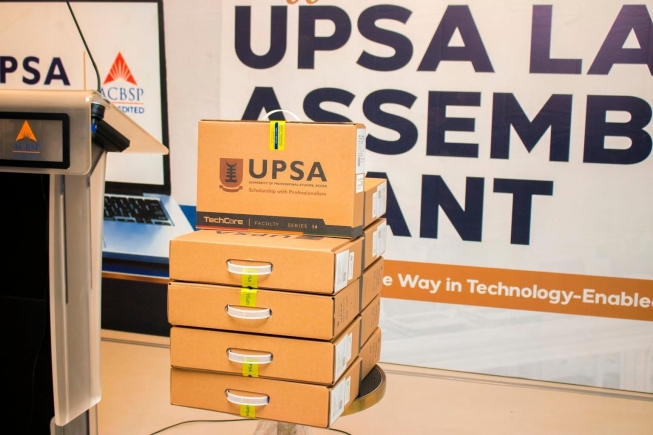
The University of Professional Studies, Accra (UPSA) has begun training students to assemble laptops at its new assembly plant, giving them hands-on experience in technology production while they pursue their degrees.
The first 25 laptops have already been assembled by students after three days of practical training, with the university planning to extend participation beyond Information Technology students to learners across faculties.
The Vice-Chancellor, Prof. John Kwaku Mensah Mawutor, said the initiative was designed to bridge the gap between classroom theory and practical skills and equip students with skills for greater self-reliance after graduation.
Experience
He said students would gain experience in hardware assembly, dismantling devices, software, and the integration of artificial intelligence with hardware.
Prof. Mawutor said the facility had the capacity to produce about 1,000 laptops a week, with the potential to increase output through additional working hours.
He said UPSA also intended to make the facility available to businesses seeking to develop and produce their own technology brands.
According to him, companies could bring their brands, source the required components and use the facility for assembly, thereby creating a link between university training and industry.
Prof. Mawutor said UPSA also hoped eventually to produce about 30 per cent of the components used in its laptops locally, as part of efforts to build local technological capacity rather than rely solely on imported finished products.
Prof. Mawutor said participation in the initiative would not be restricted to IT students, with learners from disciplines, including accounting and marketing, also being exposed to the facility.
He said the multidisciplinary approach would enable students to gain practical knowledge of technology while understanding the business opportunities associated with it.
The facility comprises an assembly room, research room, ageing and testing room, classroom and practical room.
It also has an X-ray machine for detecting faults in devices, while UPSA provides after-sales service and warranty support.
Prof. Mawutor said UPSA wanted every student to have access to a laptop and was developing a financing arrangement that would allow students to acquire the computers and pay over time.
He said the university did not want the cost of the devices to become an additional burden on students.
Building an ecosystem
The Executive Director of the National Society of Black Engineers (NSBE), Mr Abdulai Moro, said the initiative marked a shift from theory-dominated education to learning through production.
He urged UPSA to build an ecosystem around the plant, including repair hubs, software services, e-waste recycling and student technology businesses.
Mr Moro said the sustainability of the initiative would depend on reliable supply chains, a viable market for the products, maintenance systems and adherence to international quality standards.
He also urged the university, industry and government to ensure that the plant did not become another project that attracted attention at its launch and later lost momentum.
Describing the student-assembled laptop as more than a product, Mr Moro called it a “practical transcript” through which students could build competence, confidence and employability.
Affordable financing
The Director of Information and Communication Technology at the Bank of Ghana (BoG), Mr Peter Kwabena Annor, who represented the Governor, Dr Ernest Addison, said affordable access to computing devices was increasingly important to Ghana’s digital transformation.
He said students without computers could struggle to participate fully in digital learning, while small businesses lacking appropriate digital tools could also be disadvantaged in areas such as record-keeping and digital financial services.
Mr Annor urged UPSA to collaborate with regulated financial institutions to develop student-friendly instalment plans for the laptops.
He also proposed similar financing arrangements for teachers, young entrepreneurs and small businesses.
He stressed the need for transparent pricing, affordability assessments, manageable repayment terms and consumer protection to prevent digital inclusion efforts from creating unsustainable debt.
Mr Annor said Ghana’s digital transformation should be measured not only by technological sophistication but also by the accessibility and affordability of technology to ordinary people.
Consumers to producers
Dr Clement Dzato said students needed practical skills to assemble, maintain and repair technological devices rather than depend entirely on imported expertise.
He urged policymakers and universities to prioritise programmes that equip young people with skills for employment and self-reliance.
A representative of the La Nkwantanang-Madina Municipal Assembly also expressed the Assembly’s readiness to collaborate with UPSA, including discussions on providing space for related activities.
