
The government will undertake 210 major infrastructure interventions to transform secondary education across the country under the $300 million World Bank financing.
They include the construction of 10 new secondary schools, rehabilitation of 150 existing schools, upgrading of 30 Category C schools to Category B, upgrading of 20 Category B schools to Category A and the procurement of furniture for the beneficiary institutions.
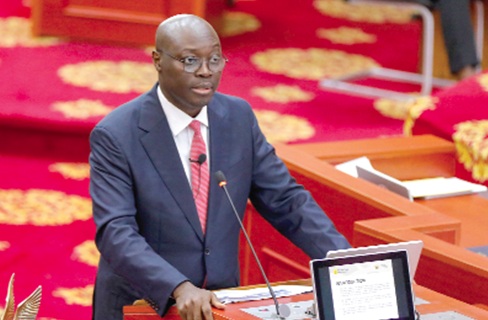
Presenting the 2026 Mid-Year Fiscal Policy Review in Parliament last Thursday, the Minister of Finance, Dr Cassiel Ato Forson, said the 10 new secondary schools would be strategically distributed to improve access in underserved areas.
Investments
“Education remains one of the most powerful investments we can make in the future of our country.
The government is, therefore, taking bold steps to transform secondary education through a US$300 million World Bank financing,” he said.
The Finance Minister said one new school each would be constructed in the Western, Western North, Greater Accra, Volta, Oti, Northern, Upper East, Upper West, Savannah and Central regions and that upon completion, the project was expected to benefit about 2.3 million students, over 100,000 teachers and about 2,000 school leaders across the country.
“The project will support the government’s efforts to eliminate the double-track system, improve learning outcomes particularly in mathematics and science, expand female participation in Science Technology, Engineering and Mathematics and technical vocational education and training education, and equip our young people with the digital, technical and green skills required for the jobs of the future,” he said.
Access
Dr Forson said the government continued to expand equitable access to quality education and remove financial barriers facing Ghanaian children, and that, in line with that, it had fully paid capitation grants for the first and second terms of the 2025/2026 academic year.
Also, he said the government had absorbed the examination registration fees of 478,699 public-school Basic Education Certificate Examination candidates and 407,271 West African Senior School Certificate Examination candidates.
“Daily feeding grants for students in special schools was almost doubled to GH¢15 from GH¢8 and that “ the government is also strengthening the supply of food to senior high schools through improved funding and supply-chain management under the Free Secondary Education Programme.
Dr Forson said under the No Fees Stress Policy, the government paid the first-year academic fees of 165,143 students in public tertiary institutions for the 2025/2026 academic year and that under the Free Tertiary Education for People with Disability Initiative, the government also provided full tuition and residential support to 1,554 students with disabilities in public tertiary institutions.
Payments
To give real meaning to Free Compulsory Basic Education, GH¢76 million as Capitation Grant had been paid, and to provide nutritious meals and keep children in school, GH¢877 million to the Ghana School Feeding Programme had also been paid.
Moreover, he said, to ease the burden on families, GH¢46 million for BECE registration had been paid and to remove financial barriers to tertiary education, GH¢537 million for the No Fees Stress Policy had been paid.
On teacher trainees, Dr Forson said an amount of GH¢104 million as teacher trainee allowance had been paid to support them.
To promote skills development and entrepreneurship, an amount of GH¢45 million for the National Apprenticeship Programme had been paid.
