
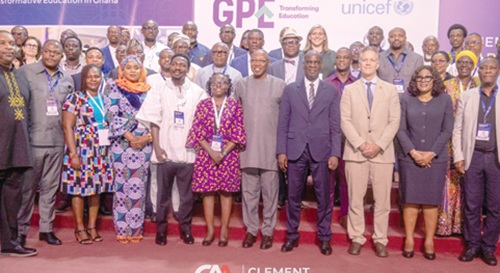
The Ghana National Education Campaign Coalition, a group of civil society organisations in the education space, has welcomed the focus on artificial intelligence (AI) in the nation's education agenda.
It, however, said technology must serve education and not dictate its priorities, adding that the measure of success must be improved learning, stronger teaching, reduced inequality, and greater opportunity for every learner.
“AI cannot compensate for weak foundational literacy, numeracy and social-emotional skills because they remain essential to all our future learning.
AI can support teachers to identify learning gaps, provide differentiated practice and feedback, and expand access to local language and accessible learning resources.
“It must complement and not replace qualified teachers, effective pedagogy, adequate learning materials, safe schools, and human relations at the heart of education,” the National Coordinator, Ghana National Education Coalition Campaign, Bernice Mpere-Gyekye, stressed at the 2026 National Education Week celebration.
It was on the theme: “Harnessing artificial intelligence for inclusive and transformative education in Ghana”.
Observation
Mrs Mpere-Gyekye observed that, unfortunately, UNICEF's 2025 Education Budget Brief reported that more than 60 per cent of children in Ghana did not achieve basic literacy and numeracy by the end of primary school.
“NaCCA's curriculum implementation research also identified a gap at Primary Four. Numeracy was expected to account for 21 per cent of curriculum implementation, while classroom observation found approximately 11 per cent coverage.
“Teachers and head teachers pointed to limited learning materials and financial constraints as barriers to effective delivery,” she pointed out.
On the implementation of AI in basic schools, Mrs Mpere-Gyekye urged the government to make inclusion non-negotiable, stressing that unequal access to electricity, reliable connectivity, devices, and technical support risked widening existing inequalities.
“Rural learners, children from low-income households, girls in disadvantaged communities, and learners with disabilities must not be left behind or treated as an afterthought.
Initiatives
“AI-in-education initiatives should provide accessible platforms, assistive technologies, affordable and low-bandwidth tools, local language content, and offline options where needed,” she added.
Mrs Mpere-Gyekye urged the government to put teachers and learners at the centre, insisting that teachers needed sustained professional development and practical classroom-level support, not one-off technology training.
For his part, the spokesperson for the development partners in education, Andy Brooks, said even though AI presented extraordinary possibilities for education, it also posed a risk, citing recent global research, which raised concerns about the potential impact of AI on children's learning and development, as well as their mental health.
“When students use AI to take shortcuts — skipping the hard work of critical thinking, problem-solving, and making mistakes — they may complete assignments more quickly without actually developing the skills and comprehension that they need,” he stressed.
“There are also emerging concerns about the implications of AI for children's social relationships and their mental well-being,” Mr Brooks, who is also the Country Representative of UNICEF, said.
He proposed that learning outcomes and not technology must be put at the centre of learning, stressing that technology in education was not new.
“For decades, we have invested in computers, tablets, digital content, and learning platforms —often with great enthusiasm, but without always seeing the corresponding improvements in what children actually learn.
“With AI, we have an opportunity and a responsibility to do things differently.
As Ghana develops its National AI in Education Roadmap, we are encouraging the government to establish clear expectations for evidence generation and evaluation right from the beginning.
“Every major AI education initiative should have a credible plan to assess its impact on teaching and learning, not simply measure how many devices are distributed or how frequently a platform is used,” he stated.
Email:
