
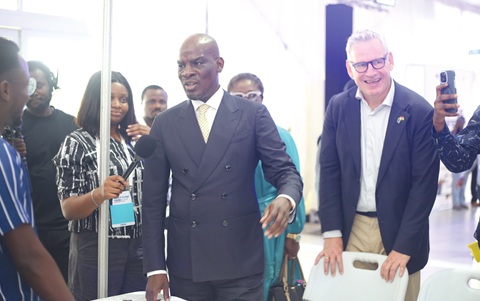
The Minister of Education, Haruna Iddrisu, has called on European universities to partner with Ghanaian tertiary institutions to offer joint degree programmes and make internationally recognised qualifications more accessible to students.
He said such arrangements would enable more Ghanaian students to obtain international-standard qualifications without having to travel abroad for their entire programmes.
Mr Iddrisu made the call at the opening of the Study in Europe Fair 2026 at the University of Ghana, Legon.
The fair was held on the theme: “Discover, connect and go further”.
He proposed joint and double-degree programmes, credit transfers and collaborative research as ways to improve access to higher education and strengthen local institutions.
An estimated 8,000 to 10,000 Ghanaian students are currently studying at higher education institutions in Europe, he noted, adding that the cost of overseas education remained a challenge for many qualified students.
Mr Iddrisu identified climate-resilient agriculture, tropical medicine, renewable energy and digital transformation as areas where partnerships could be developed.
He also called for more scholarships and research opportunities in science, technology, engineering and mathematics (STEM), technical and vocational education and training (TVET), artificial intelligence and green technologies.
Such partnerships, he added, could help address brain drain while giving Ghanaian students and researchers access to European research facilities and expertise.
He also urged European countries to ensure fair and efficient visa processing and provide structured industrial placement opportunities for students.
Study opportunities
The European Union (EU) Ambassador to Ghana, Rune Skinnebach, described the fair as the first of its kind in the country.
He said it was intended to provide young people with reliable information on scholarships, admission requirements and visa procedures for studying in Europe.
The event featured exhibition booths where students interacted with representatives of European universities and scholarship organisations. Other activities included an Erasmus+ information desk, a curriculum vitae clinic and a session on preparing successful applications.
Students also had the opportunity to engage with alumni and members of the Team Europe Youth Sounding Board.
The Deputy German Ambassador to Ghana, Sarah Pfaffernoschke, said more than 3,000 Ghanaian students were studying in Germany, representing more than double the number recorded in 2020.
She disclosed that Ghana and Germany had established 68 university partnerships to support student mobility, research and knowledge exchange.
Germany and the EU had also reached thousands of students through information sessions and established Study in Europe desks at 30 institutions to provide guidance on educational opportunities in Europe.
International partnerships
For his part, the Pro Vice-Chancellor responsible for Academic and Student Affairs at the University of Ghana, Professor Gordon Awandare, said the fair aligned with the university’s strategic plan for 2024 to 2029.
In a speech read on his behalf by a Professor of Medical Microbiology at the university, Professor Nicholas T.K.D. Dayie said the plan prioritised transformative student experiences, impactful research, engagement and partnerships.
He said the fair provided students with an opportunity to explore academic programmes, scholarships and international mobility opportunities, including the Erasmus+ programme, as well as learn from the experiences of alumni.
Professor Awandare encouraged students to engage with participating institutions, ask questions and explore programmes that aligned with their academic interests and career aspirations.
