
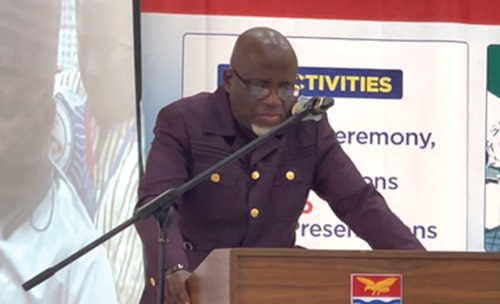
A Former Vice-Chancellor of the University of Ilorin, Nigeria, Professor Is-haq Olanrewaju Oloyede, has challenged West African leaders and policymakers to rethink their approach to language diversity, arguing that multilingualism should be seen as a powerful tool for regional integration and development rather than a barrier to progress.
He said the real challenge facing the sub-region was not the existence of multiple languages but the failure of governments and institutions to build systems capable of harnessing linguistic diversity for social, economic and political advancement.
Prof. Oloyede made the remarks while delivering the keynote address at an international conference organised by the Department of French of the University of Cape Coast (UCC) in honour of a former Vice-Chancellor of UCC, Prof. Domwin Dabire Kuupole.
The conference, held on the theme: “Coexistence of Languages in West Africa for Sustainable Regional Integration,” also featured the launch of Prof. Kuupole’s autobiography titled From Kraal to Crown.
Challenge
“Multilingualism itself is not our problem.
The real challenge lies in our failure to build institutions, educational systems, translational cultures and regional habits strong enough to carry linguistic diversity productively,” he stated.
Addressing participants from across West Africa and beyond, Prof. Oloyede described the gathering as more than an academic event, saying it was a celebration of scholarship, mentorship, leadership and human impact.
He paid glowing tribute to Prof. Kuupole, whose contributions to language studies, higher education governance and regional academic cooperation had left an enduring mark on Ghana, West Africa and the global academic community.
“A conference in his honour is not a ceremonial assembly; it is intellectual justice that must be done,” he stressed.
Regions
Prof. Oloyede noted that West Africa remained one of the most linguistically diverse regions in the world, with thousands of languages spoken across the continent and over 80 languages in Ghana alone.
Despite this richness, he said many African countries continued to operate governance and educational systems that privilege colonial languages while neglecting indigenous ones.
“The danger is not that West Africa speaks many languages.
The danger is that our political imagination has too often been narrower than our linguistic reality,” he said.
He argued that language was far more than a means of communication, describing it as a powerful instrument for social engineering, education, economic development and regional cooperation.
He said multilingualism became a burden only when it was poorly managed through weak institutions, inadequate language policies and limited investment in translation, teacher training and language technology.
Intelligence
Prof. Oloyede further criticised the tendency to equate intelligence and education with fluency in English, French or Portuguese, warning that such attitudes continued to undermine indigenous African languages.
Lasting impact
Speaking on behalf of the Chancellor of UCC, Sir Sam Jonah, the acting Vice-Chancellor, Professor Denis Worlanyo Aheto, described Prof. Kuupole as a visionary leader whose contributions transformed the university.
He said Prof. Kuupole's tenure witnessed major academic reforms, infrastructural expansion and institutional growth.
The conference brought together scholars, researchers, policymakers and language experts from across West Africa to examine the role of multilingualism in advancing regional cooperation, education and sustainable development.
