
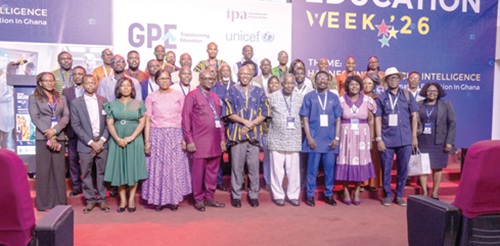
The Deputy Education Minister, Dr Clement A. Apaak, has charged teachers to exercise the professional judgement needed to ensure that artificial intelligence (AI)-supported content is accurate, appropriate and aligned with the approved curriculum.
“We must embrace innovation without losing the essential human, intellectual and social dimensions of education.
“Technology is a means to an end, and every investment must contribute to better teaching, improved learning, and expanded opportunities for our children and young people,” Dr Apaak said when he officially closed the 2026 National Education Week activities.
2026 Education Week
The conference, on the theme: “Harnessing artificial intelligence for inclusive and transformative education in Ghana”, created a national platform to provide opportunity for dialogue, knowledge exchange, and strategic planning on the role of AI in transforming Ghana’s education sector, ensuring alignment with the National AI strategy and the Resetting Ghana agenda.
It brought together policymakers, educators, researchers, academia, student and teacher bodies, private sector, development partners, civil society organisations, faith-based organisations, non-governmental organisations and traditional authorities to explore how AI can be effectively deployed across all levels of education, from basic, secondary, tertiary, technical and vocational education and training (TVET), and complementary and inclusive education.
AI and foundational learning
Dr Apaak said learners must develop the critical thinking skills to question and assess information obtained through AI, adding, “AI cannot substitute for strong foundational learning; rather, it should complement and strengthen efforts to improve education quality.”
He said the introduction of AI and other digital technologies must remain firmly grounded in the fundamental purpose of education, “which is ensuring that every learner acquires the knowledge, skills, values and competencies needed to fulfil their potential and to contribute meaningfully to society.
“Technology must, therefore, be guided and judged by its contribution to improved teaching and learning,” the deputy minister stressed.
Addressing the participants, Dr Apaak expressed the ministry’s deepest appreciation to all the stakeholders whose significant contributions, commitment and effective participation had made the 2026 National Education Week a resounding success.
“The insights emerging from this week reflect our shared demonstration and determination to build a more inclusive, equitable and transformative education system for our dear nation,” he said.
He said the deliberations that went on at the conference represented critical policy questions that would shape the future direction of the country's education system, “because whether we like it or not, the role of technology in education delivery is bound to continue.
The clock is not going to turn backwards”.
Dr Apaak added that the discussions so far underscored the need for robust policy frameworks to guide the responsible and ethical use of artificial intelligence in the education system.
“It has also highlighted the importance of safeguarding ethical standards, protecting our vulnerable learners, strengthening teacher preparedness, and ensuring that technological innovation contributes to improved learning outcomes and educational quality.
“The discussions have also emphasised that technology should serve as an enabler of quality education rather than as a substitute for the human element that remains central in teaching and learning,” he said.
