
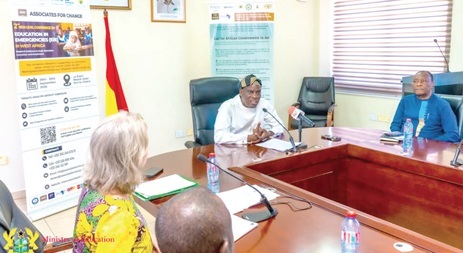
Ghana will next week play host to the Second High-Level Conference on Scaling Education initiatives in Emergencies (EiE) in the West Africa sub-region.
The two-day event to be held from September 29-30, 2026, would be attended by representatives of Ministries of Education, researchers, development partners, innovators, financiers and regional bodies across the globe.
EiE refers to quality learning opportunities for all age groups in situations of crisis, including conflicts, forced displacement, natural disasters and public health emergencies such as the COVID-19 pandemic.
The EiE conference is organised by Associates for Change, a research think-tank based in the country, as well as the Centre for Studies in Economies of Africa, Nigeria, and the Centre for Studies, Research and Training for Social and Economic Development in Burkina Faso.
Promotion
It aims at promoting the use of policy-relevant evidence to scale education innovations that improve access, learning, continuity, safety and well-being of children and young people affected by crisis.
The Minister of Education, Haruna Iddrisu, who announced the hosting of the conference at a media briefing in Accra yesterday, noted that the global evidence was sobering and that an estimated 72 million crisis-affected children were out of school altogether.
Another 127 million, he said, were sitting in classrooms but not attaining minimum learning outcomes because the systems around them had been disrupted.
“That is a generation in two parts: one locked out, and one present but not learning. West Africa carries a heavy share of that burden. Insecurity across the Sahel has emptied schools in Burkina Faso, Mali, Niger and northern Nigeria. Displacement does not respect borders, and neither does the loss of learning,” he said.
Policy
Mr Iddrisu said the policy experience was cases that justified the focus on EiE, which undoubtedly threatened inclusion in education.
“COVID-19: In March 2020, we closed every school in this country. Millions of learners from kindergarten to university were sent home, and for many of them the better part of a year passed before they returned.
“We improvised: radio lessons, television broadcasts, online platforms.
But a child in a community without electricity, without a radio, without a smartphone, simply waited.
Some never came back. We saw dropouts, we saw a rise in teenage pregnancy, and we saw learning losses that our foundational literacy and numeracy results still carry today.
COVID-19 did not create the weaknesses in our system. It exposed every one of them,” he said.
On the Akosombo and Kpong Dam spillage in October 2023, Mr Iddrisu said communities in North Tongu, Central Tongu, South Tongu and Ada were submerged, and tens of thousands of people were displaced.
Survival
Schools, he said, went underwater and those that survived were turned into shelters for the displaced, which meant that even where a building stood, teaching stopped and that furniture, textbooks, records, and examination preparation were gone in days.
The Education Minister said children sat the same national examinations as their peers in dry classrooms.
“Tidal waves and coastal erosion: Along Keta, Anloga and Ketu South in Fuveme, Agavedzi, Salakope, Amutinu and elsewhere, the sea has taken homes and school buildings outright.
This is not a single event to be recovered from. It is an annual, advancing loss, and it is the clearest evidence that climate change is now an education problem in Ghana.
“Floods in the north: Each rainy season, spillage from the Bagre Dam and seasonal flooding across the Upper East, North East, Northern, Savannah and Oti regions cut off communities, wash out roads and keep children away from school for weeks at a time in the very districts where our access and learning indicators are already weakest,” he said.
Conflict
The situation in Bawku, he said, and tensions elsewhere had closed schools, disrupted examinations, and driven teachers out of communities that could least afford to lose them, adding, “Where a teacher does not feel safe sleeping in a town, that town loses its school, and a child's education becomes a casualty of a dispute they had no part in”.
In response to a question, he said, “Every other year, we want to dedicate two per cent of the annual allocation of GETFUND to support the Ministry of Education to deal with such emergencies so that if there is a storm, a fire outbreak of a boys' or girls' dormitory or some other event, the ministry can come in”.
The Director of Associates for Change, Dr Leslie Casely Hayford, said the organisation was working in Ghana, Nigeria, Burkina Faso and other parts of West Africa, including Liberia and Sierra Leone.
Those areas, she said, had been affected by conflicts and that some of the factors behind them were not only chieftaincy and land disputes but also illegal mining and poverty.
