
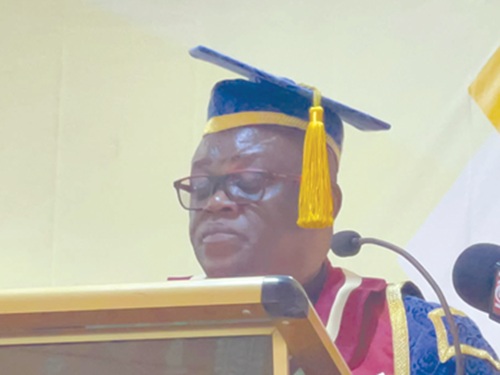
The Principal of the Komenda College of Education, Very Rev. Professor Kwesi Nkum Wilson, has called for a government policy to compel private schools to employ professionally trained teachers to help address teacher recruitment and deployment challenges in the country.
He said such a policy would ensure that professionally trained teachers were given opportunities to practise their profession while improving the quality of teaching and learning in private schools.
Prof. Wilson made the call at the 2025 graduation ceremony of the college at Komenda in the Central Region, held on the theme: “Sustaining quality teacher education, embracing innovative pedagogy and digital tools for the 21st Century classroom.”
He noted that some teachers who were trained in early childhood education sometimes found themselves teaching at the junior high school level, while those trained for the junior high school level were also deployed to early childhood education.
Prof. Wilson said the policy would not only create opportunities for trained teachers but also ensure that private schools benefited from the professional competencies of teachers trained for the job.
“Private schools should be compelled as well to recruit trained teachers,” he said.
He noted that such a policy would help resolve some of the challenges associated with the placement of professionally trained teachers and ensure that teacher deployment was guided by training and competence.
College development
Prof. Wilson revealed that the college graduated 457 students, out of which 128 obtained first-class degrees; 245 second-class upper division, 76 second-class lower division, with seven obtaining third-class.
He said the college currently had 1,511 students, with males constituting 50.29 per cent and females 49.7 per cent.
Government response
Responding to the proposal, the Technical Advisor and Director of Pre-Tertiary Education at the Ministry of Education, Stephen Owusu, said the government had already begun discussions with the leadership of private schools on the issue.
He said a committee was working on the issue and that the outcome of the discussions would determine the next steps.
Mr Owusu also acknowledged challenges with teacher deployment, particularly situations where teachers were moved from positions for which they have been trained because of personal requests or influence.
Embrace technology
The Bishop of the Cape Coast Diocese of the Methodist Church Ghana and Council Chairman of Komenda College of Education, Prof. Richardson Aboagye Andam, noted that teachers could no longer afford to ignore emerging technologies and innovative teaching methods.
Drawing on his experience as a young teacher, he said he had once learnt to use computers at a time when his school had no ICT teacher.
He said he and some colleagues who were trained in subjects such as Biology, Geography and Mathematics volunteered to learn computer skills and teach their students.
Prof. Andam added that his ability to use computers later enabled him to join the school's examinations committee and eventually provided examination-printing services for other schools.
He said the experience demonstrated how acquiring an additional skill could create opportunities beyond one's formal job description.
Skills and integrity
The Dean of the Faculty of Vocational Education at the University of Skills Training and Entrepreneurial Development (USTED), Prof. Gilbert Owiah Sampson, added that education should ultimately translate into competence, service and impact.
He said certificates alone were no longer enough and that graduates needed to be able to apply knowledge, solve problems, adapt to changing circumstances, create opportunities and contribute to their communities.
Valedictorian
The Valedictorian, Celestina Andoh, noted that the graduating class had overcome significant academic, emotional and personal challenges before reaching the graduation stage.
She said her studies in Mathematics and ICT had taught her perseverance, problem-solving and resilience.
