
A total of 2,038 students have graduated from Central University at its 25th congregation, held last Wednesday, with 212 of them obtaining first-class honours.
The graduates comprised 1,692 undergraduates and 346 postgraduate students from the School of Architecture and Design, Central Business School, School of Engineering and Technology, Central Law School and Faculty of Arts and Social Sciences.
The Chancellor of the university, Rev. Mensa Otabil, formally constituted the assembly into the 25th congregation for the conferment of degrees.
The Vice-Chancellor of the university, Prof. Samuel Kwasi Dartey-Baah, congratulated the graduates on their achievement, commending them for their hard work, sacrifices, determination and perseverance throughout their academic journey.
He urged them to uphold the values of faith, integrity and excellence as they entered the next phase of their lives.
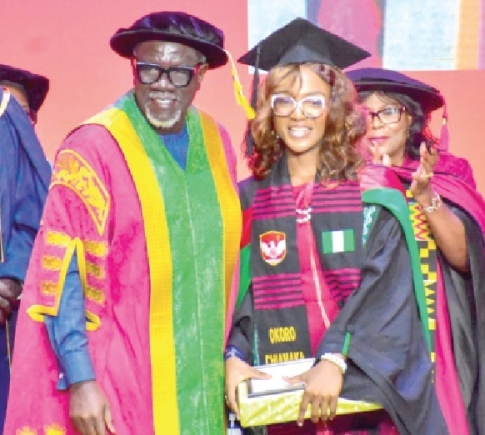
The overall best graduating student, Okoro Chiamaka Faithful, obtained a Cumulative Grade Point Average (CGPA) of 3.95.
Prof. Dartey-Baah said the university remained committed to its vision of raising virtuous and transformational leaders through excellence in teaching, learning and research.
He disclosed that the university admitted 3,240 new students in the 2025/2026 academic year, reflecting continued confidence in the institution.
Development initiatives
He outlined some of the university's recent achievements, including the construction of an anatomy and histology laboratory to support its Bachelor of Medicine and Surgery programme.
The School of Pharmacy, in partnership with Ernest Chemist Limited, has also secured a 250,000 Euro grant to develop and validate a standardised herbal medicine formulation.
On infrastructure, he said the university was finalising a build-operate-transfer arrangement to develop student accommodation facilities with an initial capacity of at least 2,000 beds.
He added that the university was adopting a phased approach to operationalising its hospital, with medical laboratory and X-ray services expected to begin in the first quarter of 2027.
Prof. Dartey-Baah appealed to the government to create a more enabling policy environment for private universities.
He called for equitable access to research funding, support for faculty development, greater participation in national education planning and fair consideration of private university students under national student financing initiatives, including the No-Fees-Stress Policy.
He said stronger collaboration between public and private tertiary institutions was necessary to build a knowledge-based economy.
The Vice-Chancellor urged the graduates to remain adaptable and committed to lifelong learning in the face of rapid technological changes, particularly artificial intelligence.
He encouraged them to create opportunities, solve problems and contribute meaningfully to national development, stressing that their success should also be measured by the positive impact they made on society.
The valedictorian, Ms Faithful, reflecting on the graduates' journey, said their university experience had gone beyond obtaining academic qualifications to include personal growth, self-discovery and the development of lasting relationships.
