
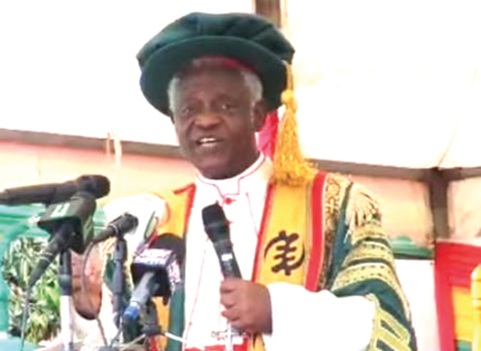
The Chancellor of the Catholic University of Ghana (CUG), Peter Cardinal Appiah Turkson, has challenged graduates to look beyond their academic certificates and use their knowledge to promote truth, integrity, compassion and human dignity.
He said the call was particularly important amid growing misinformation, political polarisation and declining ethical standards.
Cardinal Turkson made the call at the university’s 25th Congregation and 38th Matriculation Ceremony at Fiapre in the Bono Region, where 2,806 students graduated and approximately 1,810 newly admitted students were matriculated.
He said academic qualifications alone could not solve society’s challenges without moral responsibility, critical thinking and a commitment to the common good.
Statistics
The university recorded its highest-ever new-student enrolment, admitting 3,648 students during the 2025/2026 academic year, against a target of 3,200.

The ceremony
The development brought its total student population to more than 8,300.
The graduating class comprised 668 postgraduate and 2,138 undergraduate students.
Of the undergraduates, 91 obtained first-class honours, 1,124 earned second-class upper honours, 925 secured second-class lower honours and 11 graduated with third-class honours, while none obtained a pass.
The School of Nursing and Midwifery produced the highest number of graduates, with 1,736.
The ceremony also marked the graduation of the university’s first PhD student.
Ethical challenges
Addressing ethical challenges confronting the modern world, he said societies were increasingly being shaped by opinions and ideologies that often lacked critical examination, constructive dialogue and a genuine commitment to establishing the truth.
He described the global environment as one marked by volatility, uncertainty, complexity and ambiguity, with climate change, wars, political unrest, disruptive technologies and declining public trust in institutions making solutions increasingly difficult to achieve.
Cardinal Turkson said the challenges required a renewed commitment to ethical principles that protected human dignity, promoted peaceful coexistence and strengthened collective responsibility.
Invoking the Golden Rule, he reminded the graduates: “Do unto others what you would have them do unto you.”
He said the principle remained essential to building harmonious societies and ensuring that people treated one another with fairness, dignity and respect.
The Chancellor outlined four ethical principles to help societies confront global challenges: vulnerability, unlearning, compassion and answerability.
He explained that recognising shared human vulnerability should encourage people to support one another rather than retreat into fear, hatred, tribalism and populism.
Cardinal Turkson urged individuals and institutions to unlearn outdated assumptions and remain open to new ideas, stressing that dialogue and collaboration were necessary to overcome divisions.
On compassion, he cautioned against the disregard for truth and scientific evidence, arguing that empathy should guide how people understood the experiences and needs of others.
He described answerability as the willingness to ask difficult questions, accept responsibility and work collectively towards practical solutions.
Cardinal Turkson called for a global ethic anchored in honesty, fairness, peace, hope and reconciliation, insisting that moral responsibility must also extend to environmental protection.
Funding support
The Vice-Chancellor of the university, Professor Mathew Glover Addo, called on the government to establish a dedicated fund to support private tertiary institutions and strengthen their contribution to national development.
He said competition from public universities and government tuition-support interventions for first-year students in public institutions had implications for the enrolment prospects of private tertiary institutions.
Prof. Addo said preparations to establish a Faculty of Law were advanced, with the university targeting January 2027 to commence the programme, subject to regulatory approval.
Writer’s email:
