
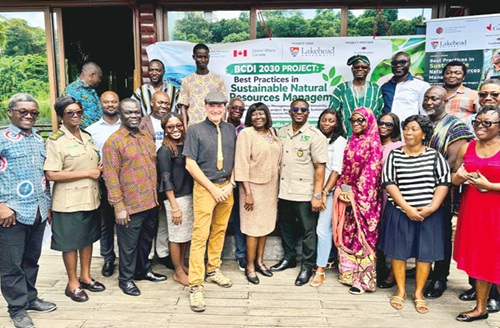
A Total of 35 Ghanaians, made up of students, researchers, academia and industry players, are to benefit from a five-year Canadian Dollar (CAD) $570,000 grant awarded to Canada-based Lakehead University’s Faculty of Natural Resources Management.
It is under the programme dubbed “Best practices in sustainable natural resources management” and was awarded as part of the Canadian International Development Scholarships 2030 (BCDI 2030).
BCDI is a unique international development programme that harnesses higher education to strengthen social and economic development across 26 developing countries.
It is an eight-year $80 million programme funded by Global Affairs Canada and delivered through partnerships between Canadian and partner country post-secondary institutions.
Ghana’s part
In the case of Ghana, three master’s students will be awarded full scholarships to study at Lakehead University, while nine members from the partner institutions will also benefit from one-month scholar opportunities.
The partner institutions are Forestry Commission, University of Ghana, University of Energy and Natural Resources, University of Cape Coast and University for Development Studies.
The rest are Kwame Nkrumah University of Science and Technology, CSIR College of Science and Technology, Sarmartex Timber and Plywood Company, Charcoal Chamber of Commerce-Ghana and CSIR-Forestry Research Institute of Ghana (CSIR-FORIG).
The grant, which focuses on wood science and technology, remote sensing/geomatics and ecological studies, will support 23 early-to-mid-career officers from the institutions through a tailored certificate programme.
Signing of MoU
At a press briefing and partner meeting at the CSIR-FORIG in Kumasi last Wednesday, October 14, 2026, the Principal Investigator, Faculty of Natural Resources Management, Lakehead University, Professor Mathew Leitch, said the award of the grant was preceded by the signing of a memorandum of understanding (MoU) with the partner institutions in 2020.
He said the goal was to focus on three key areas of the programme and to train more people to improve the lives of Ghanaians as well as safeguard the environment from continuous destruction.
He said that, given the devastating impact of illegal mining on the environment, remote sensing technologies, combined with forestry and wood science, could help protect the environment for the benefit of future generations.
“There is knowledge we have in damaged areas that have been brought back to life. In the case of Ghana, we do have knowledge and technologies to help fix the menace of illegal mining,” he indicated.
Best ways
The Director of Operations Plantations, Forest Services Division, Forestry Commission, Valerie Fumey Nassah, said the intervention was one of the best ways that can help in achieving the capacity building gap faced by the commission.
As a result, she said it would enable the commission to implement all the interventions towards ensuring sustainable natural resource management and added that the project was useful in the wake of numerous attacks on forests by illegal activities.
“If we can monitor in real time, we will be able to ensure a reduction in the destruction of forest reserves.
Whatever we learn will be brought to bear in the management of the forest resources,” she stated.
Other speakers
The Head, Centre for Climate Change and Gender Studies, University of Energy and Natural Resources, (UENR), Professor Mercy Afua Adutwumwaa Derkyi, said the programme would build their capacity in knowledge, skills and the strengthening of the partnership.
She said, “Everyone has a role to play to minimise the environmental crises which are confronting us today”.
In a welcome address, a former Deputy Director, CSIR-FORIG, Dr Beatrice Darko Obiri, underscored the need for the institutions to create the conditions to enhance the capacity for efficient development of solutions relevant to Ghana’s natural resource management needs.
Writer’s email:
