
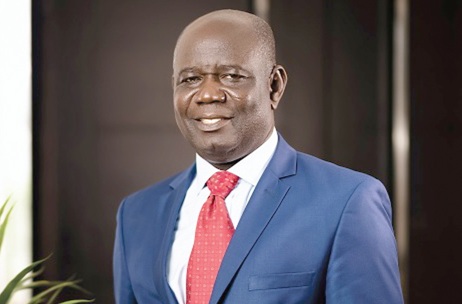
The Administrator of the Ghana Education Trust Fund (GETFund), Paul Adjei, has expressed concern that inadequate investment in educational infrastructure could undermine the country's capacity to accommodate students seeking admission into Senior High Schools (SHSs).
He said the allocation of a substantial portion of GETFund's resources to the Free Senior High School (Free SHS) programme, coupled with the growing infrastructure deficit, posed a challenge to efforts to expand educational facilities to meet demand.
MPs’ concern over stall projects
The administrator disclosed that the free SHS was expected to take GH¢5.6 billion out of the fund's projected revenue of GH¢11.2 billion in 2027, leaving significant demands on the remaining resources for other educational interventions, including infrastructure development.
He made the disclosure when management of GETFund appeared before the Committee on Public Administration and State Interest to account for its financial performance and respond to concerns about stalled educational projects across the country.
The administrator made the disclosure following concerns by members of the committee about stalled educational infrastructure projects in their constituencies, with some MPs reporting that educational projects had remained incomplete for four, five and even six years.
Stalled projects
The GETFund administrator described inadequate investment in educational infrastructure as worrying since investments in new classrooms and other facilities were necessary to accommodate students entering the second-cycle education system.
He said the Fund was concerned about the number of educational projects that had remained incomplete or “stalled” for several years, some dating back to previous administrations.
"We all come from villages, and then when you go and you see some of these projects having been left for so many years, we feel so bad about it," he told the committee.
He explained that although GETFund had established an Education Financing and Partnership Department to mobilise resources outside government, its principal source of financing remained allocations approved by Parliament.
Mr Adjei said the GH¢5.6 billion expected to go into Free SHS in 2027 represented a substantial commitment of the Fund's projected revenue.
"And this is something that if these funds were to be invested into the construction of facilities, it would do so much," he said.
He, however, explained that the decision to allocate resources to Free SHS was a policy decision beyond the authority of GETFund management.
"But these are decisions that are above us.
You know, the President thinks that this is the best way to go about it and since we are there to represent the President's vision, we are guided and minded to ensure that we carry it out to the letter," he added.
Comprehensive assessment
The GETFund administrator acknowledged the concerns and disclosed that management had undertaken a comprehensive assessment of stalled projects to establish their status and determine how they could be completed.
He said the fund would submit a schedule of the stalled projects to the committee by Friday to enable members to examine the situation and provide direction.
Concerns
The MP for Ahanta West, Mavis Kuukua Bissue, for instance, raised concerns about the prolonged delay in completing GETFund-sponsored educational infrastructure projects in her constituency, saying some had remained unfinished for “between four and six years”.
She cited several stalled facilities, including a Makaranta facility intended to serve the Muslim community and questioned what measures GETFund was taking to ensure their completion.
"I am asking this because in my constituency, I have a few GETFund projects that have been abandoned.
One belongs to the Muslims, which is the Makaranta and so I actually want to know what is going to be done about them and how it is being managed," Mrs Bissue asked.
She cited political interference and the lack of continuity in project execution when governments changed as a major contributory factor to such negative development.
"So, what I am thinking is that sometimes political interference gets in the way and so how are we going to stop this political interference from getting in the way so that we can have continuity when governments change and then these projects cannot continue without stalling?" she asked.
The Chairman of the committee, Kwaku Asante-Boateng, described GETFund projects that had stalled for more than two years as “abandoned projects".
