

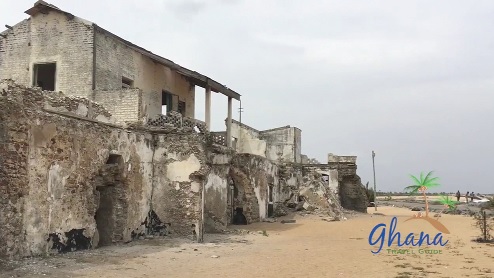
Stand at Keta and look towards Fort Prinzenstein, and you get a disturbing lesson in the fragility of history. The sea is not interested in heritage.
It does not care that European powers once built forts along Ghana’s coast, that these buildings witnessed the gold trade and the transatlantic slave trade, or that tourists now travel from across the world to encounter the stories embedded in their walls.
The sea simply keeps coming. And that is why climate change should be a tourism conversation.
When we discuss climate change, tourism is rarely the first thing that comes to mind.
We talk about rising temperatures, floods, droughts, melting ice and disappearing forests. Yet tourism is a very physical business. Attractions occupy land. Historic buildings have foundations. Beaches have shorelines. Ancient paintings are made on rocks.
When the environment changes, tourism feels it. A recent global assessment of heritage sites has warned that extreme weather, rising sea levels and coastal erosion are threatening cultural treasures in different parts of the world. Africa is particularly exposed.
Ghana should pay attention. The country's coastline is dotted with castles and forts built between the late 15th and 18th centuries.
They stretch for hundreds of kilometres, carrying the architectural fingerprints of Portuguese, Dutch, British, Danish, Swedish and other European traders.
These are some of Ghana's most important tourism assets and historical archives. But parts of the coastline are changing faster than our conservation efforts.
At Fort Prinzenstein in Keta, erosion has eaten into the structure. Compare photographs from decades ago with images of the fort today and the message is unmistakable: portions of the building have crumbled, while the sea has steadily claimed the surrounding land.
What happens when the attraction itself begins disappearing? That question is not unique to Ghana. On the Red Sea coast of Sudan lies Suakin, an ancient port whose history stretches back about 3,000 years.
It served as a gateway for trade and exploration in ancient times and later became an important stopping point for Muslim pilgrims travelling to Mecca. It was also entangled in the history of the Red Sea slave trade.
Suakin eventually lost its commercial importance after Port Sudan was developed further north. Today, its remains include old houses and mosques. But coastal erosion and rising sea levels are now adding another chapter to its long decline.
Further south, Lamu Old Town in Kenya offers another warning.
Lamu is the oldest and best-preserved Swahili settlement in East Africa and has been continuously inhabited for more than 700 years. Its architecture and traditions make it an important centre for understanding Swahili and Islamic cultures.
But the shoreline is retreating. Natural protection from sand, vegetation and mangroves has weakened, leaving the historic settlement more exposed to flooding and coastal change.
The Comoros Islands face similar dangers. The archipelago contains historic settlements including Mutsamudu, a 14th-century maritime town on Anjouan. Yet the islands are among the African locations considered highly vulnerable to sea-level rise and coastal erosion.
The warning extends beyond the coast.
At Twyfelfontein in Namibia, thousands of ancient rock engravings provide an extraordinary record of the lives and ritual practices of hunter-gatherer communities. Climate change could alter the normally dry environment, increasing humidity and creating conditions favourable to fungi and microbial activity that can damage rock surfaces.
In Djenné, Mali, the problem concerns the very material from which the town was built.
The approximately 2,000 mud houses of Djenné are among West Africa's most recognisable architectural treasures. The town has been inhabited since ancient times and became an important centre of commerce and Islamic learning.
But climate and environmental changes are affecting the availability of the high-quality mud traditionally used for construction and repairs.
Cheaper materials are increasingly being used, gradually changing the character of the historic town. This is the new challenge for heritage conservation.
For generations, preservation meant protecting historic places from neglect, vandalism, development and human conflict.
Now another threat has entered the picture: the changing climate. And Africa cannot afford to treat this as somebody else's problem.
Castles, forts, historic towns, monuments and archaeological sites generate tourism, provide employment and give communities a physical connection to their past. Ghana therefore needs to put climate risk firmly inside its heritage and tourism planning.
Coastal monitoring, regular documentation, conservation engineering and digital technologies such as 3D scanning can help record vulnerable sites and, where possible, slow their deterioration.
But documentation should not become an excuse for surrender. A digital model of Fort Prinzenstein may preserve its shape. It cannot reproduce the experience of standing inside its walls.
The bigger lesson is that climate change is not only changing the weather. It is changing the tourism map.
The next generation may inherit fewer heritage sites than we did, not because history became less important, but because we failed to protect the places where that history lives.
The sea has no memory. We do. Our responsibility is to make sure that, before the water takes the buildings, we have done everything possible to keep their stories standing.
