

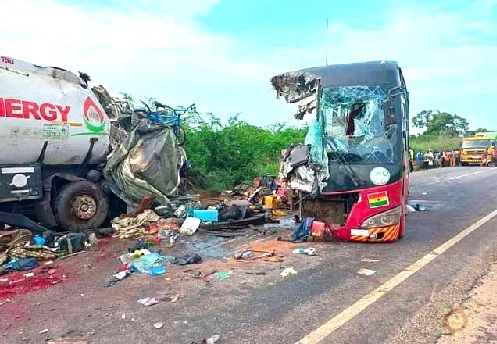
There is something deeply unsettling about travelling in Ghana these days. The journey that should take us to a beach, a waterfall, a festival or a historic monument can suddenly become a grief journey.
The recent succession of road crashes across the country has brought this reality painfully close. The fatal crash at Ofankor, where 11 people reportedly lost their lives and 13 others were injured in a multiple-vehicle collision, is another grim reminder that our roads are not merely infrastructure.
They are spaces where human lives are being wagered every day.
For those of us interested in tourism, this should set off a particularly loud alarm.
Tourism begins with movement. Before the visitor sees the castle, photographs the mountain, swims in the lake or tastes the local dish, the visitor must first get there. And in Ghana, road transport remains the principal means of reaching most of our tourism destinations.
The road, therefore, is part of the tourism experience. Unfortunately, it is increasingly becoming the most dangerous part. The statistics are sobering. Ghana recorded 2,673 road deaths between January and November 2025, an 18.5 per cent increase over the previous period. The same data recorded more than 13,000 crashes and over 15,000 injuries.
The situation has not improved in 2026. In January alone, road fatalities reportedly rose from 261 in 2025 to 383 this year. In Greater Accra, the January figure more than doubled, from 21 to 50 deaths.
These are not just numbers. Each number represents a passenger who had somewhere to go. And some of those passengers were tourists.
But there is another way of looking at the problem. A road accident involving a tourist does not end with the injured traveller or the damaged vehicle. It can affect the reputation of an entire destination.
Imagine a visitor returning home with photographs of Cape Coast Castle, Kakum, Mole or Lake Bosomtwi but telling friends that the most frightening part of Ghana was the drive between destinations. That is not the destination marketing message we want.
Tourism is fundamentally about confidence. Visitors must feel reasonably confident that they can move around safely. When that confidence weakens, itineraries become shorter, travellers become more cautious, and tour operators face greater difficulty selling road-based excursions.
A family contemplating a weekend drive from Accra to the Volta Region, Central Region or Ashanti Region may think twice if stories of fatal crashes dominate the news.
A school planning an educational excursion may become more cautious. A company arranging a retreat may choose a destination closer to Accra rather than risk a long-distance journey.
The economic consequences travel beyond tourism. Hotels lose guests. Restaurants lose diners. Tour guides lose assignments. Attractions lose visitors. Transport operators lose business. Communities that depend on tourist spending lose income.
This is why road safety should not be treated as somebody else's problem. The National Road Safety Authority says human factors account for roughly 90 per cent of road crashes, with speeding, inattentiveness and loss of control among the leading contributors.
Speeding alone has been identified as responsible for a substantial proportion of crashes.
The driver who overtakes on a blind curve is not merely taking a personal risk. He is putting passengers, pedestrians and other motorists in danger.
The driver who has been behind the wheel for hours without rest is not simply trying to meet a schedule. He may be carrying tourists, workers, students or an entire family towards a preventable tragedy.
The same applies to overloading, drink-driving, drug-impaired driving and the use of unroadworthy vehicles. But responsibility does not end with drivers. Road safety requires good engineering, effective policing, reliable emergency response, proper vehicle inspection and meaningful enforcement.
A broken-down vehicle left dangerously on a highway can become a death trap. Poorly designed intersections, inadequate pedestrian crossings and insufficient lighting can turn ordinary journeys into hazards.
There is some encouraging news. The tourism sector itself is beginning to recognise the connection.
In August, the Ghana Tourism Authority Ex-Staff Association launched a five-year, $400,000 road safety and tourism project aimed at improving road safety and restoring confidence in travel.
The Tourism Minister described road safety as directly connected to tourism, trade and investment.
This is a welcome development. But we need to go further. Every tourism operator who puts visitors into a vehicle should regard road safety as part of the tourism product. Tour companies should have clear safety protocols.
Drivers should be properly licensed, rested and trained. Vehicles should be inspected regularly. Tourists should be encouraged to use seatbelts, and journey schedules should allow realistic travel times rather than forcing drivers to race against the clock.
We should also begin to promote a new tourism ethic: the journey matters as much as the destination.
For too long, our tourism conversation has concentrated on attractions, accommodation, food, festivals and marketing. These are important.
But none of them matters if the visitor cannot arrive safely. We cannot continue to mourn today, hold a road safety seminar tomorrow and return to business as usual the day after.
A safe journey is not an extra attraction. It is the beginning of the attraction.
