

It was around 11 p.m. on May 25, 2024, when Emmanuel Ehun, popularly known as Nuelz, realised that his wife, Naomi Mikafui Ehun, was slipping away.
Her body was growing cold and she could no longer swallow the medication he was administering. She had also been unable to speak for about two weeks.
Holding her in his arms, he called her elder sister, hoping for help, before reaching out to a doctor from their church. What followed was the heartbreaking confirmation that the 29-year-old woman he had married barely two years earlier was gone.
“Within the two years of our marriage, it was only six months, I should say, that she became very much okay. Aside from that, it was just full of pains and tears,” Mr Ehun recalled to The Mirror in Accra last Tuesday.
For Mr Ehun, the loss was not only the end of a love but the end of the future they had planned, including having children.
Yet, in the months that followed, he found a reason to keep going in a promise she had made before her death: if she recovered, she wanted to educate people about breast cancer.
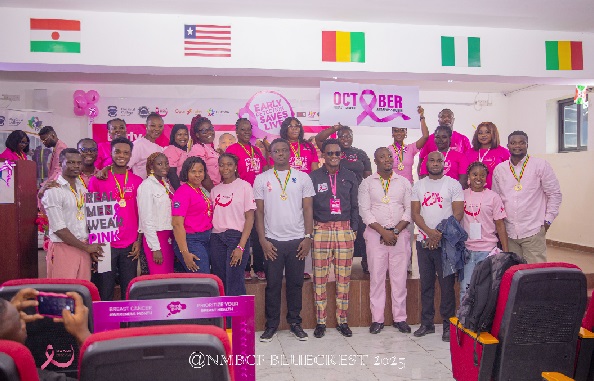
Today, that wish lives on through the Naomi Mikafui Breast Cancer Foundation, which he established in her memory to promote breast cancer awareness, education and screening. Mr Ehun also runs his own firm, Nem Engineering Company Limited.
A lump they thought was harmless
Growing up in Winneba in the Central Region, Mr Ehun attended Dombo Catholic School for his basic education before moving to Accra for his Senior High School education at National Technical College.
He later proceeded to the Accra Technical University, where he studied Quantity Surveying and Construction Economics, graduating in 2015 after completing a top-up programme.
That same year, he met his late wife. They eventually married in 2022, but before their wedding, she had occasionally complained of pain in her left breast.
“Before marriage, she wasn't experiencing it that severely. She was just saying, ‘Oh, there's some pain in my breast,’” he said.
They visited three polyclinics for help, but according to Mr Ehun, each time the health workers examined the lump by touch and reassured them that it was not something to worry about and that it’d go away on its own.
After their marriage, however, the pain became severe as the lump grew. About six months into the marriage, his late wife’s condition had deteriorated to the point where she could barely carry out her normal activities.
He noted that they sought further medical attention and were eventually referred to the Tema General Hospital, where a core biopsy was performed. The results confirmed that she had breast cancer.
Further tests for potential surgery to remove the lump identified the cancer as triple-negative invasive breast carcinoma, which Mr Ehun said doctors classified as stage three.
Following the diagnosis, she was referred to the Korle Bu Teaching Hospital for chemotherapy and radiotherapy. The couple soon had to confront not only the demands of treatment but also the possibility that it could affect their plans to have children.
Failed attempt at IVF
Concerned that chemotherapy could affect their chances of having children, the couple explored In Vitro Fertilisation (IVF) and egg storage. They travelled from Tema Community 25 to Parkman Hospital at Taifa, taking a 21-day break before chemotherapy to undergo the procedure.
With the exchange rate at about GH¢16 to US$1 at the time, he said they spent approximately US$7,500 on the procedure, with a proposed further US$500 every six months for storage.
However, their hopes were dashed when they were told no eggs had been retrieved.
Struggling to break the news to her, he initially reassured her that everything was fine whenever she asked about the outcome, before eventually telling her the truth.
With that hope gone, they turned their attention to chemotherapy, scheduled every three weeks at a cost of about GH¢4,000 per cycle, including medication.
Mr Ehun noted that he was not working at the time, having completed a construction project and relied on its proceeds to pay for his wife’s treatment.
Effects of the treatment
Due to the treatment, she experienced hair loss, loss of appetite, reduced libido and pain. According to Mr Ehun, she would feel relatively well for only about one week during each three-week chemotherapy cycle.
He added that as the disease progressed, it spread to her spine, affecting her movement and leaving her legs numb. Her neck also became stiff, making it difficult for her to move comfortably.
“I thought she needed physiotherapy, so I had to get someone to come to the house. Then we realised she was rather deteriorating,” he said.
“The pain this young lady went through was unbearable. Any time she takes the drugs, she will be okay. But within 23 hours, when the drugs are out of the system, the pain will start again. Sometimes, we could hear her screaming from different parts of the house,” he said.
Mr Ehun commended her and his family for stepping in to help take care of her.
The weight of stigma and advice
As Naomi’s condition worsened, Mr Ehun said relatives and others urged them to try herbal remedies and prayer camps alongside her medical treatment.
The couple had initially kept the diagnosis private for fear of stigma, but some of the comments they received were hurtful.
He recalled a healthcare worker calling him a “game boy” because of his dreadlocks, while others made remarks about their sex life (now you are sleeping with a man oo) after she lost her hair or suggested he send her back to her family because it was spiritual.
“It's different if this person is my girlfriend or I'm just staying with her. This is a legally married person. How do you expect me to throw her to her family like that?” he recalled thinking.
He eventually limited visits from all of such people. He said an oncologist at Korle Bu, whom he identified as Dr Yebila, sometimes returned his calls late at night to offer guidance.
When Naomi was referred to palliative care, he became frightened and bought a book to understand what it meant. Despite his efforts to care for her and understand her condition, her health continued to deteriorate.
Coping afterwards
On how he coped after her death. Mr Ehun noted that his sister-in-law once found him hitting his forehead against the floor.
“I was told I even left home wearing only my boxers and walked to church, where I stayed for hours before my pastor found me. I don’t even remember this, so it means I was not in my right mind,” he said.
He added that he barely went out for three to four months. Although he sought help from a clinical psychologist, support from his family and church and speaking openly about his loss gradually helped him cope.
Following my late wife’s desire to create awareness of the condition, I got the encouragement of my family and established the foundation on the day she died, May 25, 2024.
The Naomi Mikafui Breast Cancer Foundation
Initially funded with proceeds from his construction work, Mr Ehun noted that the organisation had grown into about 140 members and 29 completed projects.
The foundation organises breast cancer education and screening activities in schools, churches, communities and tertiary institutions, alongside monthly webinars and workshops with health professionals. Its outreach has covered parts of the Central, Volta and Eastern regions, as well as Benin and Togo.
For Mr Ehun, breast cancer education must continue beyond October, the month dedicated to raising awareness of the disease.
“We don't wait for October. The foundation, what we do is we run all year long. I have managed to balance my construction business with the work of keeping my darling wife’s dream alive,” he said.
