

In Ghana, there are several predictable and familiar responses when someone introduces themselves as an artist. Among these, one response stands out as both interesting and disturbing.
Whether one meets an artist at an exhibition or in an ordinary social setting, people are often quick to declare their exclusion from what is a fundamental creative endeavour—one of the basic human endowments for creating and sustaining a meaningful life.
This declaration is expressed in the common admission: “I am not an artist.”
This is often accompanied by the assertion that they cannot draw to save their lives.
They explain this by recalling art classes in secondary school, where they were expected to draw objects or depict elements of their immediate environment as faithfully as possible.
They similarly recall the expectations—and sometimes the insistence—of their art teachers that whatever objects were placed before them had to be faithfully represented.
These early lessons in still life—a common pedagogical practice intended to develop students’ skills in observing and faithfully representing objects and elements of their environment—may, many years later, reveal a deeper and more troubling consequence.
The very idea of still life, as introduced and institutionalised through formal art education under British colonial rule, seems almost to have produced and reproduced an extraordinary oxymoron: a society whose life remains still; a society deprived of dynamism, mobility, imagination, and the visible signs of aliveness and intellectual pluralism.
This is not because our people were unwilling or incapable of eclectic thought, ideational flexibility, or intellectual fluency.
Rather, art—one of the fundamental means through which human beings exercise and express consciousness, and through which we create and construct meaning—was incorporated into an educational system in ways that could leave students feeling incapable of expressing themselves, even to save their own lives.
At the same time, that system cultivated a tendency to preserve reality as it was encountered, rather than question, reinterpret, transform, or reimagine it.
Students who did not study art were not spared this still-life approach to education. In science, literature, law, mathematics, business, and other disciplines, Paulo Freire described a related phenomenon through what he called the “banking model” of education: an educational system in which knowledge, in the possession of the teacher, is deposited into passive recipients rather than generated through dialogue, critical reflection, and active engagement with the world (Freire, 1970).
Whether individuals within or outside the formal school system consider themselves artists or not—or even educated or otherwise—they possess innate capacities to imagine, create, and participate in the making of their reality.
School became an institutional framework for training people to develop their abilities and to create and add value to society. Yet beneath this apparently noble objective lies a troubling truth:
The school system is not neutral.
Education and knowledge production are, in fundamental ways, political activities. Different interests and assumptions shape their structures, their curricula, and the cultures through which they are maintained. They influence what kind of population is to be produced, and for what social and economic purposes.
Education and the school system also determine what forms of knowledge are to be privileged, discounted, marginalised, or withheld.
We see this, for example, in the historical privileging of Western religious traditions within colonial education in Africa.
Even the rhythms of the school year can reveal the cultural assumptions embedded within the educational system: Christmas and Easter holidays, a school week structured around a particular religious and cultural calendar, and, in some contexts, expectations surrounding Christian worship.
The still-life approach adopted in art education, as well as the broader banking model of education, can be understood within the context of a colonial regime that struggled both politically and psychologically with questions of legitimacy.
A pedagogy of oppression therefore became useful in producing a population less inclined to question the status quo or seek alternatives to it.
The use of such pedagogy to contain a targeted society isn’t new. History has documented the example of the Slave Bible— published in 1807 by British missionaries associated with the Society for the Conversion of Negro Slaves, for use in Britain's Caribbean colonies particularly Barbados and Jamaica.
It is a redacted version of the Bible in which references to liberation and resistance were removed. Rather, it contained the virtues of obedience to governmental authority and of slaves to their slave masters. These were extolled, taught and presented as the will of God for African slaves.
The creative dynamism of African art practices—practices that reflected multiple realities, diverse African cosmologies, philosophies, and ways of understanding the world—was progressively displaced, marginalised, or formalised within institutional models that privileged particular Western conventions of representation.
Representational art was emphasised, while abstraction, experimentation, and alternative modes of seeing were often discouraged.
The capacity and potential of art to nurture social dissatisfaction and promote creative disobedience had, in effect, to be “vaccinated” against its own subversive potential. As Boris Groys observes, “The worst thing that can be said of an artist continues to be that his or her art is ‘harmless’” (Groys, 2008, p. 122).
Art had to be rendered beautiful, decorative and safe—safe enough to be taught, examined, and institutionalised without awakening in people the impulse to question, resist, or imagine alternatives to the prevailing order.
The result was an attenuated consciousness: an educational culture in which creative expression could be encouraged while its more disruptive possibilities were constrained. People could be trained to reproduce what already existed rather than to draw upon their creative impulses to question, transform, and reinvent their lives and societies.
Western-style education, in this context, could marginalise precisely those qualities—dissatisfaction and disobedience—that are often necessary for progress, innovation, and social change. For how can a society transform itself if its people are not encouraged to become dissatisfied with what exists, and courageous enough to imagine and pursue what might exist instead?
This brings us to a deeper problem with the prevailing social understanding of education. The prevailing notion that school is a good—and even great—place where people go to acquire knowledge, secure qualifications, and become “big men and women,” rather than necessarily becoming useful, critically engaged citizens, is deeply problematic.
When education becomes primarily a pathway to status, privilege, and social advancement, it can reproduce rather than challenge the inequalities embedded in society.
It creates hierarchies of knowledge and social worth that can be difficult to dismantle. It can produce a powerful and privileged class with the authority to define what constitutes knowledge, to determine whose knowledge matters, and ultimately to shape and steer the direction of society and the state around its own interests
This sense of privilege and entitlement is, in many respects, part of the residual legacy of colonialism that we, as Africans, must urgently interrogate.
Our challenge, therefore, is not simply to educate more people. It is to redefine what education means, what knowledge is for, and who has the authority to produce and define it.
How do we create an educational culture in which everyone—not merely a privileged class—is equipped and encouraged to rigorously examine, question, and reimagine the world around them?
How do we create a society in which consciousness is not trained primarily into conformity, but cultivated as a capacity for invention, critique, and transformation?
The French philosopher Michel Foucault drew attention to a related dimension of knowledge: its relationship to power. In discussing genealogy, Foucault argued that knowledge can serve not simply to establish continuity and understanding, but also to disrupt what we take for granted. In one formulation, he writes that “knowledge is not made for understanding; it is made for cutting” (Foucault, 1977, p. 154).
Knowledge, therefore, can expose the historical circumstances and power relations underlying the things we have come to accept as natural, inevitable, or unquestionable.
This is where the question of conformity becomes important. Every society has powerful mechanisms for producing and reproducing its existing social reality. Through institutions, traditions, education, culture, and everyday habits, people are continually taught—consciously or
unconsciously—what is normal, what is acceptable, and what is possible.
Dissatisfaction and disobedience therefore occupy an interesting position within society. From the perspective of those who benefit from the existing order, they may appear threatening. From the perspective of those seeking transformation, however, they can become essential social assets.
Dissatisfaction tells us that what exists is not enough.
Disobedience gives us the courage to refuse what we know must change.
Imagination allows us to conceive what might take its place.
This is where the artist enters the conversation. Artists are neither simply inside nor outside the established social order. They occupy a peculiar and often uncomfortable position within it.
They constitute a rebellious and subversive constituency—one that continually jolts us out of the comfort of accepting reality as fixed. They remind us that we are not merely passive consumers of knowledge and reality, but active participants in creating alternative forms of being and living.
The artist asks us to see what we have become accustomed to overlooking. The artist questions what we have been taught to accept as normal.
The artist challenges what we have been told is inevitable. And the artist reimagines what we have been conditioned to believe is impossible.
Perhaps most importantly, the artist reminds us that reality is not simply something we encounter—something that was already there before us, waiting to be accepted and reproduced. Reality is also something we participate in creating through the dynamic process of being human.
And if this is true, then creativity cannot be treated as a luxury reserved for artists.
It is a fundamental human capacity—and one of the most powerful resources available to any society seeking to transform itself.
Knowing all these, how do we, as Africans, first create within ourselves, the mindset needed to develop the continent and create the alternative life we want?
If still life in art education was the secondary-school experience that trained us to represent and reproduce reality, Basic Design at the university level trained the imagination to conceive what did not yet exist.
Any object or elements of our social reality could be used as ideational metaphors for reimagining form. In simple terms, the Basic Design exercise was intended to make us proficient at imagining and exploring the possible shapes and forms any fixed object or element could take, and then expressing those possibilities.
It was an opportunity to learn how to negotiate with form. It trained our eyes to look beyond the hard surface of physical reality and into the realm of imagination, where the mind could reinvent the shape of things to come.
This is the deeper lesson of art education.
We must learn to see beyond what is.
We must cultivate the courage to imagine what could be. We must not just produce graduates who can find answers but also who are curious and courageous enough to question the answers they are presented with.
We must recognise creativity not as a luxury reserved for artists, but as a fundamental human capacity—and a necessary instrument for building the Africa we want.
Whether individuals within or outside the formal school system consider themselves artists or not—or even educated or otherwise—they possess innate capacities to imagine, create, and participate in the making of their reality.
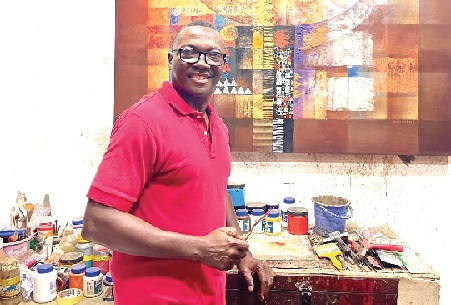
The writer is an artist.
Email:
