

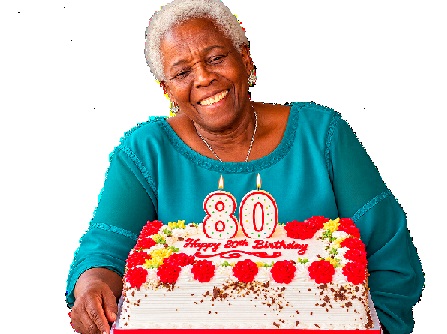
Mrs Selina Patience Kwami was one of three women among the 29 pioneering students of the Ghana Institute of Journalism (GIJ) when it was established in Accra in 1959.
Then known as Miss Patience Carboo-Sumney, she had completed her secondary education at Aburi Girls' Secondary School and enrolled at the Accra Polytechnic before deciding to change her career path.
One day, during a class, her English teacher advised her to enrol at GIJ, explaining that journalism would be more suitable for her.
She took the advice, and that marked the beginning of her journey into journalism.
In an interview with The Mirror in Ho last Tuesday, Mrs Kwami, who turns 90 next year, recounted some of her experiences as a journalist and breast cancer survivor.
She said she had the opportunity of sitting at the feet of the first principal of the institute and renowned journalist , Richard McMillan and enjoyed journalism because it exposed her to diverse people, places and experiences while providing an outlet for her passion for writing.
“In those days, we toured the whole country as part of our studies because we needed to have a fair idea of the regions to enable us to write with context,” she recalled.
During her internship at the Daily Graphic, she wrote for the Sunday Mirror and was paid for her articles.

She extended her writing to Drum magazine and a British magazine called Flamingo, which was run by a Ghanaian.
After completing her studies at GIJ, she was immediately offered employment by the then General Manager of the Daily Graphic and continued writing for the Sunday Mirror.
After two years, she left the newspaper for the Ghana News Agency (GNA) .
During her four years at the GNA, she received a fellowship that enabled her to travel to Britain, Ireland and Wales, broadening her knowledge and understanding of journalism.
She later moved to the then Ghana Broadcasting Corporation (GBC), not to work as a reporter but to learn scriptwriting.
Caught up in the1966 coup
Mrs Kwami recalled how she unexpectedly found herself caught up in the events surrounding the 1966 coup while working at the GBC.
She said she had no idea that anything extraordinary had happened until the following day, when she heard the announcement on the radio.
“That evening, I had finished work and joined the staff bus, which dropped us off at our various homes. But when we reached the gate, the security man would not open it, and we remained parked there for a long time, wondering why he was behaving like that.
“Then we realised that the security man was not the person we knew but a soldier. Still, we thought nothing of it.
“The soldier was communicating with someone in the gutter near the security post through eye movements and gestures.
Just as we were about to express our dissatisfaction with the delay, the gate opened, and we were allowed to leave. Even then, we did not realise that something drastic had happened,” she narrated.
Mrs Kwami said she was surprised the following day when she heard that soldiers had taken over GBC while the staff were at work.
She also learnt that the staff bus driver had returned to pick up the morning shift and had parked at a back entrance.
When he heard gunshots, he took cover beneath the bus, where he remained for some time before fleeing to a nearby wooden house. He stayed there until soldiers announced that it was safe for him to come out.
With activities at GBC disrupted, Mrs Kwami travelled to Germany at the invitation of a friend and began learning German.
However, she eventually returned to Ghana because of financial difficulties, as the odd jobs she was doing could not sustain her.
Back home, she secured a job as a special assistant at the newly established office of the Special Commissioner for Redeployment of Labour by the government.
She later became the Public Relations Officer of the National Vocational Training Institute (NVTI) set up by the government in conjunction with the International Labour Office to institute training standards.
In recognition of her pioneering contribution to journalism, the Ghana Journalists Association (GJA) honoured her in 1998. The Volta Regional chapter of the association also presented her with an award in 2019.
Surviving breast cancer
Mrs Kwami’s battle with cancer began when she was 64 and visiting one of her three daughters in the United States.
She had planned to stay for three months, but about three days before her scheduled return to Ghana, she felt what appeared to be a lump in her right breast while taking a shower.
She called her daughter to examine it, and her daughter insisted that they visit a hospital.
A series of tests and scans eventually revealed that she had stage one breast cancer and doctors described it as a fast-growing type.
“I was very surprised. Even though the doctors recommended removing the lump, I opted for a complete removal of the breast,” she said.
Following the surgery, Mrs Kwami began wearing a prosthetic breast. She said the adjustment did not trouble her much.
“I am an uncomplicated person, and I learn to deal with whatever comes my way,” she explained.
She returned to Ghana after a year but continued travelling to the United States for annual medical reviews.
In 2013, however, she noticed that one side of her rib cage appeared to be rising, as though something were pushing it upwards.
Scans in the United States revealed a non-cancerous growth diagnosed as a myxoid schwannoma. She subsequently underwent another operation to have it removed.
Mrs Kwami said her experience with breast cancer had made her more conscious of her diet.
“I used to be a foodie and loved sweets, chocolates and all that, but now I watch what I eat,” she said.
She expressed gratitude for the continued support of her family, particularly her three daughters and sons-in-law.
“Even though I lost my son and my husband, my three daughters and sons-in-law have been very good to me, and I thank God for that,” she said.
Although she knows both men and women can develop cancer, Mrs Kwami thinks women are more susceptible because of their reproductive systems.
She urged women to pay attention to their bodies and seek medical attention promptly whenever they notice unusual changes.
“In fact, since my treatment, I have even visited the hospital over something that looked like a mosquito bite. Until the doctor examined it, I did not feel okay,” she added.
Writer's E-mail:
