

There was a time when countries spent fortunes trying to persuade the world to pay attention to them.
Glossy brochures, international exhibitions, tourism fairs and expensive television commercials were the conventional tools of destination marketing.
Today, a compelling story told through the right screen and amplified by the right personalities can achieve what millions of dollars in advertising may struggle to accomplish.
Ghana has just received such an opportunity.
The online premiere of The Eyes of Ghana, a documentary built around the extraordinary archival work of veteran Ghanaian cinematographer Chris Tsui Hesse, presents an unusual convergence of history, cinema, celebrity influence and tourism.
With Barack and Michelle Obama's Higher Ground production company behind the project and global internet sensation IShowSpeed helping to bring it to a massive online audience, Ghana's independence story is receiving a level of international exposure that our tourism marketers could hardly have purchased through conventional campaigns.
During an online meeting on November 16, Obama endorsed IShowSpeed's proposal to make the documentary freely accessible on his YouTube channel. The following day, the film premiered online, opening its doors to an enormous international audience.
But what exactly is this film about, and why should Ghana's tourism authorities be paying particular attention?
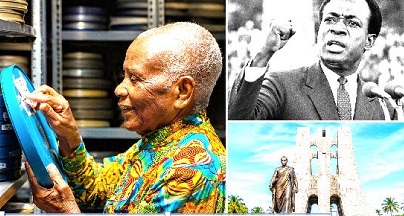
Directed by two-time Academy Award-winning filmmaker Ben Proudfoot, The Eyes of Ghana tells the story of veteran Ghanaian cinematographer Rev. Dr Chris Tsui Hesse, now 93, who served as the personal cameraman to Ghana's first President, Dr Kwame Nkrumah.
For decades, my good friend Hesse documented the activities of Nkrumah, Ghana's independence movement and the wider African liberation struggle.
Following the 1966 coup that removed Nkrumah from office, much of the footage he had recorded was reportedly destroyed. Fortunately, Hesse had preserved copies of more than 1,300 reels in a London vault (I advise that you watch his film, " You Hide Me ").
The documentary follows his race against time and deteriorating eyesight to recover, digitise, preserve and bring this remarkable historical archive to public attention.
It also highlights the contribution of younger Ghanaian filmmakers, including talented Anita Afonu, who helped advance the preservation effort.
The film is particularly significant because it presents an African story through images captured by an African witness. They are visual records of a people asserting their right to determine their destiny.
IShowSpeed's decision to make the documentary available free to his vast YouTube audience is particularly significant.
It takes the film beyond conventional cinema distribution and places Ghanaian history directly before a generation that consumes information, entertainment and travel inspiration through digital platforms.
Indeed, this development takes us back to an observation made in this column in January 2023 when we discussed futuristic tourism trends.
One of the emerging predictions is travel inspired by film and television locations.
People are increasingly choosing destinations after watching productions filmed in those places. The screen is becoming a travel agent!
The Eyes of Ghana takes this phenomenon a step further. Rather than merely showcasing beautiful scenery, it offers a compelling historical narrative capable of inspiring visitors to experience the actual places associated with the story.
The Kwame Nkrumah Memorial Park suddenly becomes a physical extension of a story that millions of people may have watched online.
The old Parliament House, Independence Square, the former Flagstaff House, the Black Star Square precinct and other locations associated with the independence struggle could become meaningful stops on a carefully curated historical tourism trail.
This is where Ghana's tourism authorities must move beyond congratulatory statements and embrace strategic action.
First, the Ghana Tourism Authority, working with the Ghana Tourism Federation, the National Commission on Culture and relevant heritage institutions, should develop an Eyes of Ghana Heritage Trail.
The trail could connect the Kwame Nkrumah Memorial Park, Independence Square, Osu Castle, historic Accra and other significant sites associated with the independence movement.
Guided experiences should combine the historical narrative with archival photographs, film extracts, personal accounts and contemporary interpretation.
Second, Ghana must aggressively pursue digital destination marketing. The documentary's online premiere should be treated as a major promotional window.
The tourism authorities should engage IShowSpeed's team and the film's producers to explore opportunities for destination features, behind-the-scenes material, short historical clips and follow-up digital content showcasing Ghana.
Third, we must develop film-induced tourism as a deliberate component of our national tourism strategy.
Visitors should be able to book themed excursions, educational tours and heritage experiences inspired by the documentary.
Fourth, Ghana should use this opportunity to strengthen its audiovisual heritage industry.
A properly resourced national audiovisual preservation programme, supported by digitisation and public access initiatives, could unlock countless other stories waiting to be told.
The film offers an opportunity to reconnect with the African diaspora and introduce younger generations to a chapter of history that has not always received adequate attention in international classrooms.
Chris Hesse spent decades preserving images of a nation finding its voice. Today, those images are finding a new audience through an unlikely but powerful partnership involving an American former president, a global digital celebrity and an Oscar-winning filmmaker.
If millions of people are invited to look at Ghana through The Eyes of Ghana, we should ensure that they have compelling reasons to come and see the country with their own eyes.
