

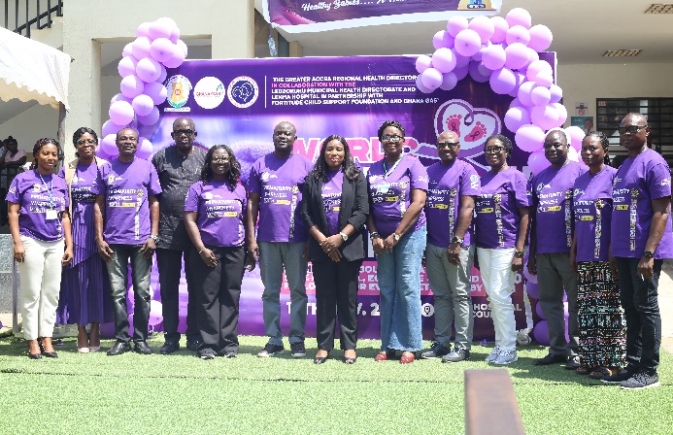
The Greater Accra Regional Health Directorate has cautioned parents against relying on social media advice and unverified home remedies when caring for premature babies, urging them to seek professional medical attention at health facilities.
The Greater Regional Director of Health Services, Dr Robert Amesiya, said although social media had become an important source of information, some of the health advice shared on such platforms could be misleading and potentially endanger the lives of premature babies.
He said some parents who relied on information and remedies obtained from social media eventually reported to hospitals when their babies' conditions had deteriorated, sometimes making it difficult for health professionals to provide the necessary care.
“Our appeal is that people shouldn't wait at home, give these babies concoctions and follow social media on what you do when you have a premature child, but come to the health facilities,” he said.
Event
He made the remarks at the 2026 World Prematurity Day celebration, organised by the Greater Accra Regional Health Directorate in collaboration with the Ledzokuku Municipal Health Directorate and LEKMA Hospital on Tuesday (November 17), in Accra.
The 2026 World Prematurity Awareness Month is being observed under the theme: “Every Journey Matters: Safe Referral, Equitable Care and Follow-up for Every Preterm Baby.”
Variations
Dr Amesiya explained that premature babies could develop different complications, including jaundice, respiratory distress and feeding difficulties, making it dangerous for parents to apply remedies based on the experiences of other families.
He noted that the complications associated with premature births varied from one baby to another, requiring individual assessment and appropriate treatment by qualified health professionals.
“Every patient is unique, and your patient is adequately known after the multidisciplinary team has assessed the patient and decides that these are the priorities that we should design and care for this patient,” he said.
He added that information shared on social media was not always subjected to the professional scrutiny and verification required of medical advice.
“It's not enough to seek for answers from social media, because the social media, people that put information there are not edited. It is not like a peer-reviewed forum where people ensure that only standard things are put there,” he cautioned.
Dr Amesiya, however, acknowledged that some information available on social media could be useful but stressed that parents should verify such information with trained health professionals.
He also encouraged pregnant women to undergo early health screening to identify and address conditions such as anaemia and high blood pressure, which could increase the risk of premature delivery.
According to him, early detection of these conditions would enable health professionals to provide appropriate medication and interventions to reduce the risk.
Equitable care, timely referral
The Medical Superintendent of Lekma Hospital, Dr Akua Gyimah-Asante called for stronger referral systems, equitable access to quality healthcare and sustained follow-up services to improve the survival and wellbeing of premature babies in the country.
She said the survival of preterm babies depended not on a single medical intervention or healthcare facility but on a coordinated system involving early identification, timely referral, specialised newborn care, family support and continuous monitoring.
She said the survival of preterm babies depended not on a single medical intervention or healthcare facility but on a coordinated system involving early identification, timely referral, specialised newborn care, family support and continuous monitoring.
Dr Gyimah-Asante said babies born before 37 completed weeks of pregnancy were particularly vulnerable to complications, including respiratory distress, infections, feeding difficulties, hypothermia and developmental challenges.
She stated that the arrival of a premature baby often placed considerable emotional and financial pressure on families, making it necessary for healthcare providers to consider the needs of both babies and their caregivers.
“The survival and wellbeing of a preterm baby is not determined by one intervention or one healthcare facility. Rather, it is the outcome of a continuous journey involving timely recognition, appropriate referral, skilled newborn care, family support and sustained follow-up,” she said.
“A referral should never simply be a movement of a patient from one facility to another. It must be a coordinated process that preserves continuity of care and gives every baby the best possible chance of survival,” she said.
